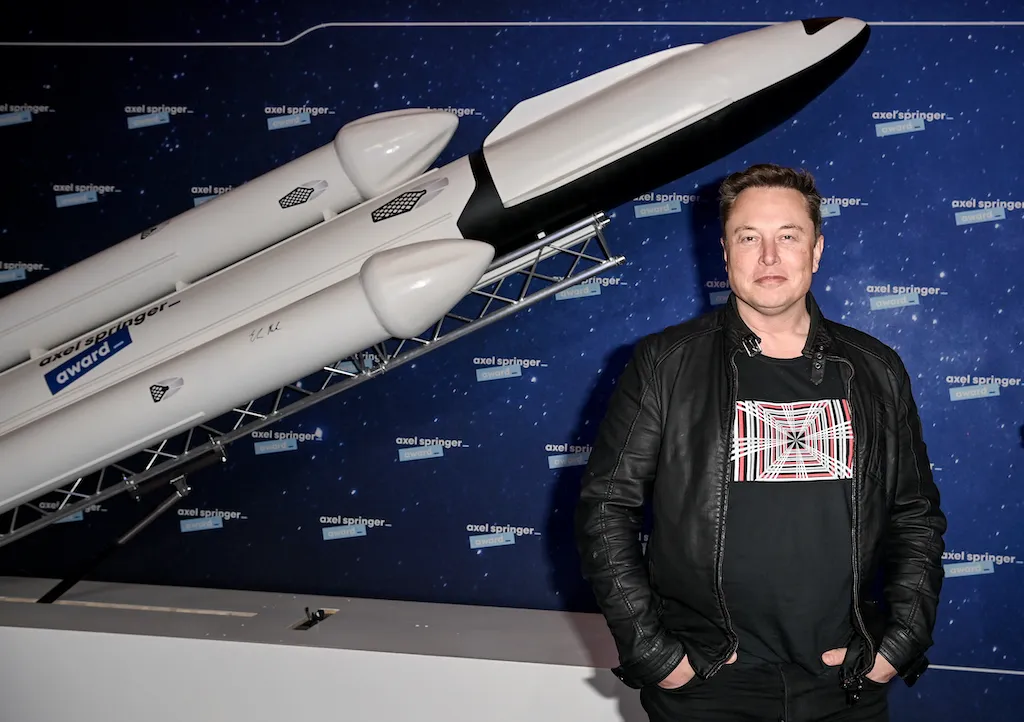
Elon Musk just crossed a new threshold. He became the world’s first trillionaire.
SpaceX’s blockbuster IPO turned out to be the largest in history, raising a record $75 billion. This resulted in Musk’s net worth being boosted past the $1.1 trillion mark.
Musk’s company was able to raise a massive amount of funds by selling more than half a billion shares, which pushed the company’s market capitalization above $2.1 trillion. SpaceX instantly became one of the world’s most valuable public entities.
Predictably, the usual suspects in the liberal media and leftist political circles simultaneously began to furrow their brows.
In true hypocrite fashion, they bandied about phrases such as “wealth inequality” and “massive wealth transfer,” in an apparent effort to manufacture yet another victim class while fomenting class envy in the process.
Calls for the implementation of additional socialist (aka communist) policies came in from Sen. Elizabeth Warren (D-Mass.) and Sen. Bernie Sanders (I-Vt.), among others.
Railing against billionaires had already been going on, despite the personal wealth accumulation of so many of the left-leaning politicians and media analysts.
It could be that an unease over unearned wealth had for some resulted in projection, i.e., accusing others of what you yourself are guilty of.
Whatever the case, the ascent to trillionaire status on the part of Musk is, in truth, an amazing validation of the free market system.
In a capitalist system, visionaries, entrepreneurs, inventors, artists, etc., have free rein to flourish.
Sometimes they are financially rewarded for their skills, talents, and efforts. It’s a beautiful thing, because when they are rewarded for their contributions, a free society reaps the benefits as well.
The Musk model is a prime example. SpaceX isn’t just another rocket company. It has fundamentally rewritten the economics of space travel.
Reusable rockets, such as Falcon 9, have resulted in the slashing of launch costs from tens of millions to a few million per flight, making the access to orbit a routine occurrence rather than a rare government-subsidized one.
Starlink, a subsidiary of SpaceX, has brought high-speed internet to remote corners of the globe, from war-torn locales and disaster zones to third-world rural villages, which has allowed millions who were previously cut off to actually connect.
SpaceX’s ambitions of Mars colonization, orbital data centers for AI, and a multi-planetary future, exhibit the kind of long-term, high-risk thinking that is the envy of the world.
The IPO itself democratizes gains through equity ownership. Over 4,400 SpaceX employees, including factory workers and engineers, turned company stock grants and options into life-changing wealth. Public shareholders now have a stake in humanity’s expansion beyond Earth.
What a cause for celebration! Instead many radical politicians and media pundits took to howling about the hoarding of wealth.
Free market proponents understand that breakthroughs have the potential to benefit everyone. Musk’s additional ventures provide perfect illustrations.
Tesla accelerated the EV transition, Neuralink pushed human-computer interfaces, and xAI is advancing safe artificial intelligence.
With each success there is a compounding effect drawing more talent, more investment, and more innovation.
Critics fixate on the amount, the actual number, and no doubt it’s a big one.
A trillion dollars.
However, naysayers generally tend to think of wealth as a single pie, with everyone vying for the biggest slice.
They’re just plain wrong. In a capitalist system in a country where people live in freedom, there’s no single pie.
Quite the opposite. There are as many pies as people dare to make.
It is a truism that ambition is an element of one’s success, financially and otherwise. So is a willingness to put in effort. And, of course, the much-needed courage to take risks.
But even if you’re not into making your own pie, in a free market system in a society that lives free, there will be lots of other pie makers who will make a pie for you or sell you a slice of your own choice.
Musk’s fortune encompasses the immense value of the creation of thousands of jobs, the incredible number of technological spillovers, the untold national security contributions, and the enormous advantages for the U.S. military and NASA, to name a few.
Thomas Sowell once said, “Capitalism is not an ‘ism.’ It is closer to being the opposite of an ‘ism,’ because it is simply the freedom of ordinary people to make whatever economic transactions they can mutually agree to.”
The SpaceX IPO exemplifies one of capitalism’s greatest strengths: Rewarding those who solve problems and who create widespread economic ripples through wealth, capital, and inspiration, boosting productivity and human progress far beyond the headline numbers.
As SpaceX stocks are traded and humanity edges closer to becoming multi-planetary, let’s be grateful rather than resentful.
Musk’s trillionaire status is proof that betting on bold ideas, such as rockets, electric cars, AI, and free speech, pays dividends for civilization.
The reaction ought not be to seek to tear him down, but rather to find out how we can encourage the next generation of builders to aim even higher.
The universe awaits.
Freedom is the fuel that will take us there.

 James Hirsen