Music is a universal language like no other.
When words seem inadequate, it speaks volumes.
So where does music come from?
We may differ in our opinions on that. But a lot of us believe that inspiration, in music as in various other art forms, literary writings, discoveries, inventions, and the like, has an other worldly origin.
Musical inspiration is particularly unique, though, because of its biblical roots and its distinct resonance within human beings across all time.
Artists who are driven to share their musical inspirations are currently facing some questions that are seriously haunting ones.
Here are a few:
1. Can technology really create the equivalent of human music?
2. Will technologically designed songs measure up to the music that human beings love?
3. Is music designed by technology really music?
There are a whole lot of music artists who are concerned about Artificial Intelligence (AI) and its supposed “creation” of musical content.
Experimentation with computers composing music has been going on for decades. But there was always a human at the helm.
Now with AI, the human is hidden. A programmer, a series of programmers, faceless, nameless, all seemingly lost, only data remain.
And we are supposed to accept the notion that data have been assigned to be our new composers?
Such so-called artistic advances in AI are prompting an interesting reaction – a mixed blend of enthusiasm, anticipation, and alarm.
A few recent examples provide insight.
A “collaboration” between famed pop musicians Drake and The Weeknd, which was actually an AI-simulated version of “Heart on My Sleeve,” went viral on social media. The track was quickly pulled at the behest of the label, Universal Music Group.
AI was used to generate an album of the highly successful British rock band Oasis. But the group had long been disbanded. Apparently, an insignificant detail.
Canadian EDM artist Claire Boucher, a.k.a. Grimes, is evidently embracing the idea of an AI version of herself.
She sent out the following advertisement of sorts:
“I’ll split 50% royalties on any successful AI generated song that uses my voice,” Grimes tweeted. “Same deal as I would with any artist i collab with. Feel free to use my voice without penalty. I have no label and no legal bindings.”
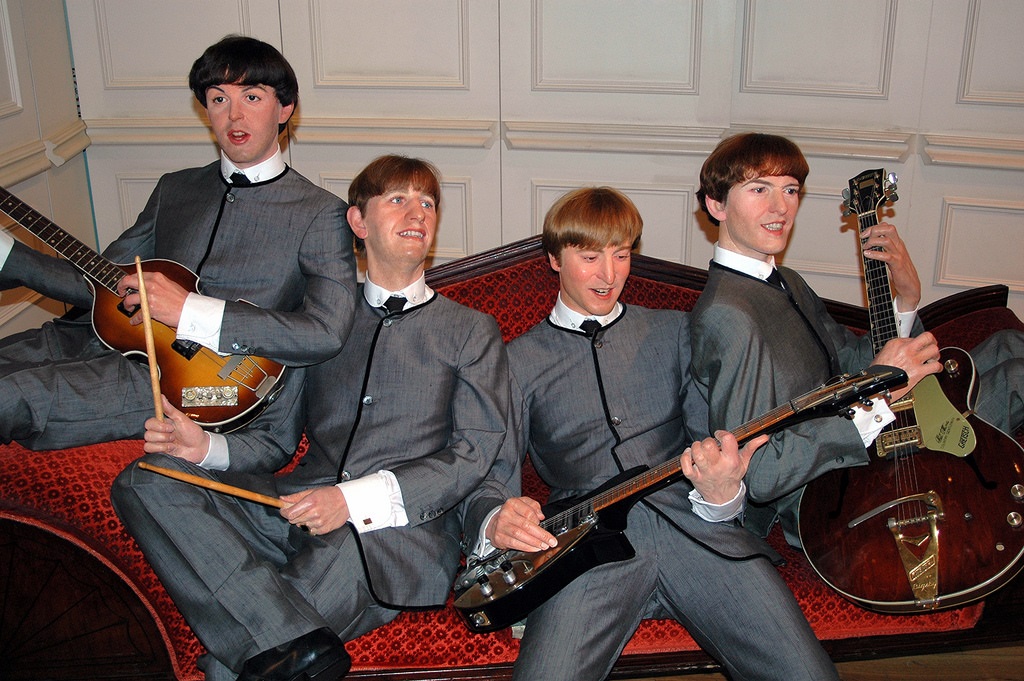
Probably the biggest story relating to all of the above involves Sir Paul McCartney. The former Beatle is one of the most influential composers and performers of all time.
McCartney has accelerated the AI discussion by announcing that the surviving Beatles would release an AI-assisted tune, which will feature vocals by the late John Lennon.
He told BBC Radio 4 that the technology was able to “extricate” Lennon’s voice from a demo recording to allow the song to be completed, and it is set to be released this year.
During the production of Peter Jackson’s documentary “Get Back,” technology was used to remove background noise from the track and otherwise clean up the audio.
“[Jackson] was able to extricate John’s voice from a ropey little bit of cassette,” McCartney said. “We had John’s voice and a piano and he [Jackson] could separate them with AI.”
“So when we came to make what will be the last Beatles record, it was a demo that John had, and we were able to take John’s voice and get it pure through this AI,” McCartney added.
Reportedly, the song is a 1978 Lennon composition called “Now and Then.”
McCartney had received the demo a year earlier from Lennon’s widow, Yoko Ono. The tracks were recorded on a boombox as John sat at the piano in his New York apartment.
Two of the songs on the demo, “Free as a Bird” and “Real Love,” were restored by producer Jeff Lynne and released in 1995 and 1996, the first Beatles release in 25 years.
The band had attempted to record “Now and Then,” but the recording session had been halted and the tune abandoned.
Now AI is facilitating McCartney’s completion of the song.
But is it really a new Beatles song? John isn’t with us anymore. How could it be?
After the announcement, some consternation appeared on various web platforms.
McCartney then backtracked a bit, taking to Twitter to assure Beatle fans that in the making of the “new” Beatles song nothing had been “artificially or synthetically created.”
It could be that McCartney is experiencing some trepidation about the use of AI for music production.
He’s certainly not alone.
According to a poll taken by the Bedroom Producers Blog, 86% of those surveyed believe the technology will replace existing tools of music production, and 73% of respondents believe AI could replace human producers in the future.
It actually doesn’t take a musician or songwriter or producer or engineer to realize that, within this context, AI is just what its name indicates – Artificial.
Thankfully, there are still those among us who are able to recognize real music and who freely acknowledge the very source of our human inspiration.

 James Hirsen
You must be logged in to post a comment.