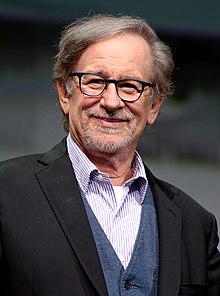
Steven Spielberg and the Hollywood Divide

The terrorist attack by Hamas, which killed 1200 unsuspecting Israeli civilians, has resulted in what Hollywood trade publications are characterizing as a “crisis.”

Despite having been affiliated with a slew of left-wing causes over an extensive course of time, many members of the Hollywood community were appalled at the sight of the October 7 massacre in Israel.

Several prominent Jewish figures within the entertainment industry have been absolutely stunned by some of the reactions and rhetoric of their fellow colleagues.

Many are questioning why organizations that purport to advocate for women’s rights have been silent about the raping of Israeli women.

Many are puzzled as to why LGBTQ groups would express support for a movement that promotes the killing of gays and lesbians.

And many are confounded at the glorification of atrocities by Black Lives Matter.

Enter Steven Spielberg.

The most commercially successful director in entertainment history and one of Hollywood’s most respected is weighing in on the October 7 carnage.

It’s a big deal for Spielberg to publicly comment on the Hamas terror attacks. A really big deal, especially for the Democratic Party.

He has donated mega-bucks to the Democrat establishment and fundraised for the Democratic Party, its candidates, and its causes.

In a recent announcement from the USC Shoah Foundation about a new campaign to record eyewitness testimony to the Hamas attacks, his comments regarding October 7 were made public.

Spielberg founded the USC Shoah Foundation in 1994, and the foundation is currently working with production teams on the ground in Israel to collect accounts of the ill-fated day.

He lauded the foundation’s team for “leading an effort that will ensure that the voices of survivors will act as a powerful tool to counter the dangerous rise of antisemitism and hate.”

He then shared his opinion of the horrific events, and he didn’t mince words.

“I never imagined I would see such unspeakable barbarity against Jews in my lifetime,” he said.

The eyes of Hollywood liberals have watched, while in Democrat-controlled cities and on Ivy League university campuses, demonstrators have overtly expressed their support of the October 7 barbarism.

Some recent videos featuring the presidents of Harvard, University of Pennsylvania, and MIT have gone viral; ones that show the individuals unable to state outright that calling for the genocide of the Jewish people violates the codes of conduct of their institutions.

This has created a major rift within the Hollywood community.

Actress Susan Sarandon was unceremoniously dropped as a client by her talent agent after she spoke at a pro-Palestinian rally.

And actress Melissa Barrera, one of the stars of the horror film franchise “Scream,” was recently fired from her role in the next installment of the series as a result of her social media posts.

On the opposite side of the spectrum, “Wonder Woman” star and former Israeli soldier Gal Gadot took to Instagram to rally support for Israel’s response to the terrorism, posting, “I stand with Israel you should too.”

And producer Matti Leshem, a self-described progressive, was quoted by The Wrap saying the quiet part out loud.

“Our problem is not right wing antisemitism. Our problem is left wing antisemitism,” Leshem stated.

The notion that the radical left poses a threat to Jewish people is a new revelation to many who have long worked in the entertainment business.

Over time the political left in Hollywood drifted away from the previously dominant centrist view; one that had affirmed strong U.S.-Israel ties and emphasized the importance of Israel’s security.

The Hollywood left became increasingly enamored with a neo-Marxist agenda that divides the world into two categories: those who are oppressors and those who are oppressed.

In addition, terms such as “colonial occupation” and “apartheid state” have been being used to describe Israel’s policies, framing those who are in leadership as the oppressors of marginalized groups.

This increasing polarization in Hollywood is creating a major divide in the entertainment community.

A divide that has the potential to dramatically alter the course of Hollywood’s political history.

Spielberg’s ‘West Side Story’ Misses the Mark

Remakes of iconic films are rarely able to match, or even come close to, the level of artistry, entertainment value, and outright magic of their original movie counterparts.

This hasn’t stopped New Hollywood from continuing to give it a try.

Steven Spielberg is the most recent one to have a go at it. Just released is Spielberg’s remake of directors Jerome Robbins and Robert Wise’s 1961 enduring musical film classic “West Side Story” (music by Leonard Bernstein and lyrics by Stephen Sondheim).

Spielberg may be wishing that he had chosen a different flick to try and reconfigure. The legendary director’s remake, which bears the original’s same name, has come up short at the box office.

The film’s estimated take for its debut weekend is around $10 million, despite its having had a production budget of about $100 million and a likely larger marketing cost. Expectations for its opening weekend had been as high as twice that amount.

Filmmaking is, of course, a uniquely collaborative art. It typically involves a large team of creative individuals who work together on a singular cinematic goal.

Sometimes everything comes together to create the perfect piece of entertainment art. That’s what happened with the original “West Side Story.” It is one of those rarities where all cinematic cylinders were fired up at peak levels.

The story by Arthur Laurents sublimely meshes with Bernstein’s musical compositions and Sondheim’s lyrics, creating a beautiful framework from which the Shakespearean inspired tale takes flight.

All things work in concert, including the impeccable casting, choreography, and screen presentation, which at the time resulted in the film’s winning 10 Academy Awards, including Best Picture.

The plot revolves around the lives of two teenagers who are madly in love with one another. Tragically, though, each one has an allegiance to family and friends of a different ethnicity and gang affiliation.

The inter-rivalry between the gangs is fierce, and they are continuously at odds with one another in an ongoing effort to dominate the New York City neighborhood.

In Spielberg’s remake, creators made what I consider to be a storytelling error that tends to worsen over the course of a movie-making process; that being, creators appear to have allowed an agenda to take precedence over fundamental artistry.

In other words, it looks as if the message derailed the medium.

In the remake of any iconic film, a mistake such as this may prove to be very troublesome. Here’s why.

In the remaking process, it is extremely important that deference to the original film be taken. This is because a classic movie has permeated society to such a degree that it has become an integral part of our shared cultural experience.

In the Spielberg version of “West Side Story,” the underlying storyline, song lyric content, and personality traits of some of the characters were significantly changed. This appears to have been done in an effort to comply with an invisible mandate contained within the film’s agenda of preference.

To compound matters, certain scenes are much less accessible, particularly for viewers who are not bilingual in English and Spanish languages. Portions of the film are actually in Spanish language only; however, there are no subtitles included, which many audiences have come to expect in such cases, and/or individual scenes.

Spielberg shared an explanation for the decision regarding language. He told IGN that the choice of not using subtitles in any of the Spanish speaking scenes was “out of respect for the inclusivity of our intentions to hire a totally Latinx cast to play the Sharks’ boys and girls.”

He also indicated that the decision was made to avoid an inequity that might be created if a language became over-empowered.

“If I subtitled the Spanish I’d simply be doubling down on the English and giving English the power over the Spanish,” he said.

Here are more ways in which the remaking process, minus the proper deference to the original, may be creating trouble for the reboot.

The late Natalie Wood, who was not of Puerto Rican descent, famously portrays Maria in the original film. Creators of the remake, likely in an effort to avoid the criticism of “cultural appropriation,” cast a Colombian American named Rachel Zegler as Maria.

Despite the apparent attempts to gain favor from those who subscribe to the tenets of the remake’s preferred agenda, the film is being slammed anyway for its ethnic insensitivity.

“I have an issue with Hollywood once again fumbling the easiest of opportunities to elevate a Puerto Rican actress. They seem to think that as long as the actors are Hispanic, that’s enough,” Daily Beast Assistant Managing Editor Mandy Velez wrote.

In terms of the music, many folks vividly remember the song “Gee, Officer Krupke,” the cleverly choreographed performance contained in the original film,

In Spielberg’s remake, the scene that contains this song and performance has unfortunately been twisted into an anti-police presentation. The setting is the 21st Precinct of the New York City Police Department, and it is here that members of the Jets proceed to mock the police and wreak havoc on the facilities.

Lyrics to the iconic “America” tune are altered as well. The snappy back-and-forth between Anita and boyfriend Bernardo about whether the U.S. is a good or bad place to live has been contorted into a flat lyric with no measurable zing.

Ditto for the original Rita Moreno scene-stealing performance. The remake seems to have put it through a redacting machine.

On a Moreno side note, the enduring star is also an executive producer of the remake, and she definitely provides some bright spots in the dull new version. She portrays a character that wasn’t in the original’s cast, Valentina, who is a widow that runs her store while simultaneously dispensing sage advice.

Too bad Doc, the “conscience” character of the original film, was left on the cutting room floor.

Other problems in Spielberg’s revised version include a lack of chemistry between lead characters Maria and Tony. This perhaps is partially due to a loss of an idealism that the original contains, as well as an innocence that is manifested by the characters.

All the seemingly forced alterations in the reboot simply don’t work. And one of the worst things about it is that this happened to a film that is considered by many to be the best movie musical in all of cinematic history.

I’ve been thinking, though, that the lackluster reboot might have the effect of bringing a whole new generation back to the movie experience of the real deal.

Young people could enjoy it with their moms and dads and grandmas and gramps, who in their drama club days sang and danced to the high school musical of their times, the original “West Side Story.”