Strike Two: Hollywood Actors Union Goes After Video Game Companies

For months now the Hollywood actors union has been on strike against the movie studios.

Now the union is seeking to authorize a second strike, this one involving major video game companies.

The current labor actions began when the Writers’ Guild of America union (WGA) went on strike in May of this year.

In mid-July, the WGA was joined by the Screen Actors Guild-American Federation of Television and Radio Artists (SAG-AFTRA).

It was historical in nature because a simultaneous strike of both actors and writers hadn’t happened in 63 years.

The actors union hasn’t gone on strike against video game companies since 2016. The strike back then lasted 11 months.

If the sought after strike addition materializes, video game actors most affected would be ones who do motion capture work and voice-overs for the video game producers.

The largest producers of video games in the world are big-name companies like Disney, EA, Activision, Epic Games, and Take Two. These are companies that are parties to the SAG-AFTRA video game contract.

The union has stated that it is asking video game companies for an 11% raise, with two 4% increases during the term of the labor contract, along with protections against AI technology.

SAG-AFTRA President Fran Drescher issued a statement about the proposed new strike.

“Here we go again! Now our Interactive (Video Game) Agreement is at a stalemate too. Once again we are facing employer greed and disrespect. Once again artificial intelligence is putting our members in jeopardy of reducing their opportunity to work. And once again, SAG-AFTRA is standing up to tyranny on behalf of its members,” she said.

Use of the term “stalemate” by the head of a prominent union doesn’t bode well for those seeking a speedy resolution to the labor turmoil in Hollywood.

SAG-AFTRA’s strike has almost completely shutdown the activities of Hollywood studios.

Talks between the industry and the unions have not been promising. There have been no breakthroughs over a long summer. The unions seem to be far away from the better wages, residuals, working conditions, and AI protections that actors and writers seek.

SAG-AFTRA needs to supplement the picketing and negotiating with additional action. Adding video game companies to the labor lockout list is one way of increasing leverage while raising public awareness.

Evaluating these strikes is a complex calculus, one with multiple variables.

Entertainment companies are very much in need of content, and the preference would be to have the labor disputes come to an end.

Powerful studio heads are concerned about how the strikes are perceived by Wall Street. The entertainment industry had been in the doldrums before the strike began. And layoffs at production companies and talent agencies certainly didn’t help the overall economy.

Additionally, the strikes have caused significant disruptions to film and television productions all over the world. According to the Financial Times, the ongoing strikes have cost the California economy about 5 billion dollars.

The consequences of the shutdown of Hollywood productions have set off a ripple effect across a large swath of local businesses; those that provide services to the movie industry, including catering, dry cleaning services, drivers, rental companies, etc.

Hollywood jobs seem to be in constant flux. The entertainment industry in general is not known for its job security. People are routinely thinking about getting out of the industry and opting for something with more employment stability.

Workers and businesses that have been affected by the strikes may decide to relocate elsewhere, and would therefore not be available if and when productions actually resume.

On the other hand, if the unions push too long and too hard on the studios, the studios may find an alternative way to obtain the content that they need.

During the 2007-08 WGA strike, the studios were unable to hire union writers. So they turned to the reality TV genre that propelled reality shows to a level in which they still lay claim to a large portion of television production.

Then there’s the elephant in the room, Artificial Intelligence (AI).

Do the work stoppages and production-set standstill become incentives for studios and production companies to accelerate the use of AI technology?

The strike may just push content executives to expedite their AI capabilities.

In fact, this seems to be happening as job postings for AI product managers offering compensation packages of $300,000-$900,000 would indicate.

The studios and streaming services are already using AI technology in the script-screening process, synopsizing stories and diminishing the need for human story analysts.

When writers and actors strike because they are afraid of being replaced by technology, will the content executives be tempted to hire compliant robots that are programmed not to picket?

Hopefully, something will give soon so the cameras can get rolling again.
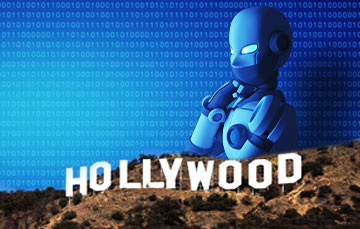
AI Is Stealing Hollywood Jobs

Believe it or not the Hollywood strike is still going on.

The problem for the members of the Writers Guild of America (WGA) and the Screen Actors Guild (SAG-AFTRA) is that right now almost nobody is paying attention to their plight.

Yes, the picket lines continue to be manned and the press conferences rage on. But something very different is going on behind the scenes.

The current strikes were initially prompted by the usual compensation-related concerns. However, this time the central issue revolves around the role that Artificial Intelligence (AI) is going to play in the future creation, production, and marketing of entertainment content.

In terms of the negotiations between labor and management, the situation is truly unprecedented, due to the technological elephant in the room.

Strikers are seeking an agreement that would set up guardrails across the industry in relation to the expanding application of AI technology.

Advances in AI are testing the law, especially when it comes to the manner in which courts are applying, interpreting, and ruling in cases that involve intellectual property.

Comedian Sarah Silverman recently brought a lawsuit in federal court against Meta and OpenAI for copyright infringement. The case is part of a proposed class action lawsuit.

Silverman in particular alleges that, without having given her consent, books that she had authored were included in the technology’s training data.

No question that actors and writers have legitimate reasons to fear the loss of their livelihoods. After all, AI has the potential to allow studios to simulate the likenesses and voices of actors in perpetuity, without ever having to compensate individuals for the use of their personal identities, characteristics, personas, etc.

Let’s not forget that AI also has the ability to create screenplays, minus the human writers.

In relation to the strike, SAG-AFTRA president Fran Drescher, best known for her starring role in the 1990s sitcom “The Nanny,” stated the following: “If we don’t stand tall right now, we are all going to be in trouble, we are all going to be in jeopardy of being replaced by machines.”

Bob Iger, who is currently a prime target of the unions, is on record as specifically having stated the drawings and videos generated by AI are “something that at some point in the future the company [Disney] will embrace.”

While speaking to a crowd gathered in Times Square, actor Bryan Cranston aimed his comment directly at Disney’s CEO, saying, “We’ve got a message for Mr. Iger. I know, sir, that you look at things through a different lens. We don’t expect you to understand who we are. But we ask you to hear us, and beyond that to listen to us when we tell you we will not be having our jobs taken away and given to robots.”

Union workers typically strike in order to increase leverage for negotiations with management.

The sad truth for both the WGA and SAG-AFTRA is that the recent strikes have increased the incentive for Hollywood employers to find ways in which they can actually prevent future strikes.

Despite the rhetoric of studio reps, AI technology equips entertainment employers to potentially avoid future strikes altogether, via drastic reductions or the complete elimination of conventional creative workers.

The Alliance of Motion Picture and Television Producers (AMPTP), i.e., the studios’ organization, has taken the position that AI should be used in what the group calls “a balanced approach based on careful use, not prohibition.”

Judging by actions as opposed to words, it appears that the major studios are tacitly embracing AI.

As a matter of fact, an AI hiring spree is currently taking place and almost every major entertainment company is involved.

— Disney has a number of open positions that focus on AI and machine learning.

— Netflix has similar job offerings, including an AI Product Manager job that promises an annual salary of up to $900,000.

— Sony is looking for what the company refers to as an AI “ethics” engineer.

— Warner Bros. Discovery, Paramount, and NBCUniversal have also joined in the AI hiring boom with their own job offerings.

It seems quite significant that Hollywood studios are seeking to fill AI jobs; this in the midst of strikes that have occurred over AI’s use itself. Tack this on to the fact that workers are having to witness layoffs that may prove to be the largest in the history of the entertainment business, including the firing of about 7,000 Disney employees.

From ancient past to present day, new inventions have historically caused the displacement of workers.

Again, though, something very different is going on. And it probably has to do with the philosophical, political, societal, cultural, and ethical transformations that are occurring simultaneously in our country and in the world.

The Hollywood strikes are likely to last a long time and may not bring a satisfactory outcome to the unions’ memberships.

So goes Hollywood, so goes the world?

Hidden Blessing in the Hollywood Shutdown

Hollywood sets have gone dark.

A central reason for the recent Screen Actors Guild-American Federation of Television and Radio Artists (SAG-AFTRA) strike is that actors, writers, and other entertainment artists are super nervous about Artificial Intelligence (AI) making them and their jobs obsolete.

When the strike was first announced, current president of SAG-AFTRA Fran Drescher was at the mike to address the press.

Drescher, the former lead actress of the 1990s hit TV sitcom “The Nanny,” heads the union that boasts a membership of over 160,000 film and television actors.

Interestingly, the writers union had gone on strike a couple of months back. But now that SAG-AFTRA has also taken to the picket line, the situation in Hollywood is looking pretty bleak.

The last time both unions were on strike simultaneously was over sixty years ago, when none other than then-actor (who ultimately turned President of the United States) Ronald Reagan was wearing the union president’s hat.

Like every other aspect of our lives, things presently appear to be out of whack.

The brand of Hollywood itself is in tatters, in large part because of the cultural and political agendas that permeate every nook and cranny of the town.

What has particularly outraged the public, though, are the productions that have been coming from major studios, chock-full of vile and inappropriate imagery, content, and messaging aimed straight at our kids and teens.

Could the Hollywood shutdown created by the two entertainment unions be a blessing in disguise?

A lot of consumers of entertainment fare are viewing it this way, as if maybe a wrench in the works was exactly what was needed to stop the madness.

Striking actors and writers have reason to be concerned about the capability of AI models to supplant human beings in the manufacture of entertainment products.

Creative types are also increasingly astonished at the sheer capabilities of generative AI models, which can digitally produce what would typically have been created by human beings, but in a faster and less expensive way.

AI ingests the works and images of human artists as part of its training data. The technology can then alter and/or mash-up content, allowing entertainment companies to avoid compensating the people who originally created the works or were even the subjects of images used.

Additionally, other creative types such as musicians and visual artists are carefully watching the entertainment biz battle, as are all those who work in an array of fields that will no doubt be affected by AI’s implementation.

We are already witnessing the technological replacement of human beings in a host of industries. Still, the entertainment business has a unique opportunity to do something helpful for society at large.

The manner in which Hollywood resolves the two strikes could set the marker, not only for the entertainment industry but for other businesses as well.

Digitally created trailers and scenes featuring what appear to be well known actors have popped up all over the internet. The virtual phenom is posing legal and ethical concerns that the unions are obliged to address.

At a recent press conference, Drescher warned, “If we don’t stand tall right now, we are all going to be in trouble. We are all going to be in jeopardy of being replaced by machines.”

SAG-AFTRA chief negotiator Duncan Crabtree-Ireland indicated during a press conference that a proposal by the studios would put background performers at a terrible disadvantage.

“They propose that our background performers should be able to be scanned, get paid for one day’s pay, and their company should own that scan of their image, their likeness, and should be able to use it for the rest of eternity,” Crabtree-Ireland said.

The Alliance of Motion Picture and Television Producers (AMPTP), which represents major studios including Walt Disney and Netflix, issued a statement suggesting that the claim made by SAG-AFTRA leadership is untrue.

An AMPTP spokesperson told ZDNET that the use of digital replicas would be restricted to the specific motion picture for which the actor is employed, and that any additional use would require the actor’s permission.

“Any other use requires the background actor’s consent and bargaining for the use, subject to a minimum payment,” the spokesperson stated.

This strike over AI is just the opening scene.

Sit yourself down and get ready for a real-life epic drama.

Only this time you’re not going to be able to say, “Don’t worry. It’s only a movie.”