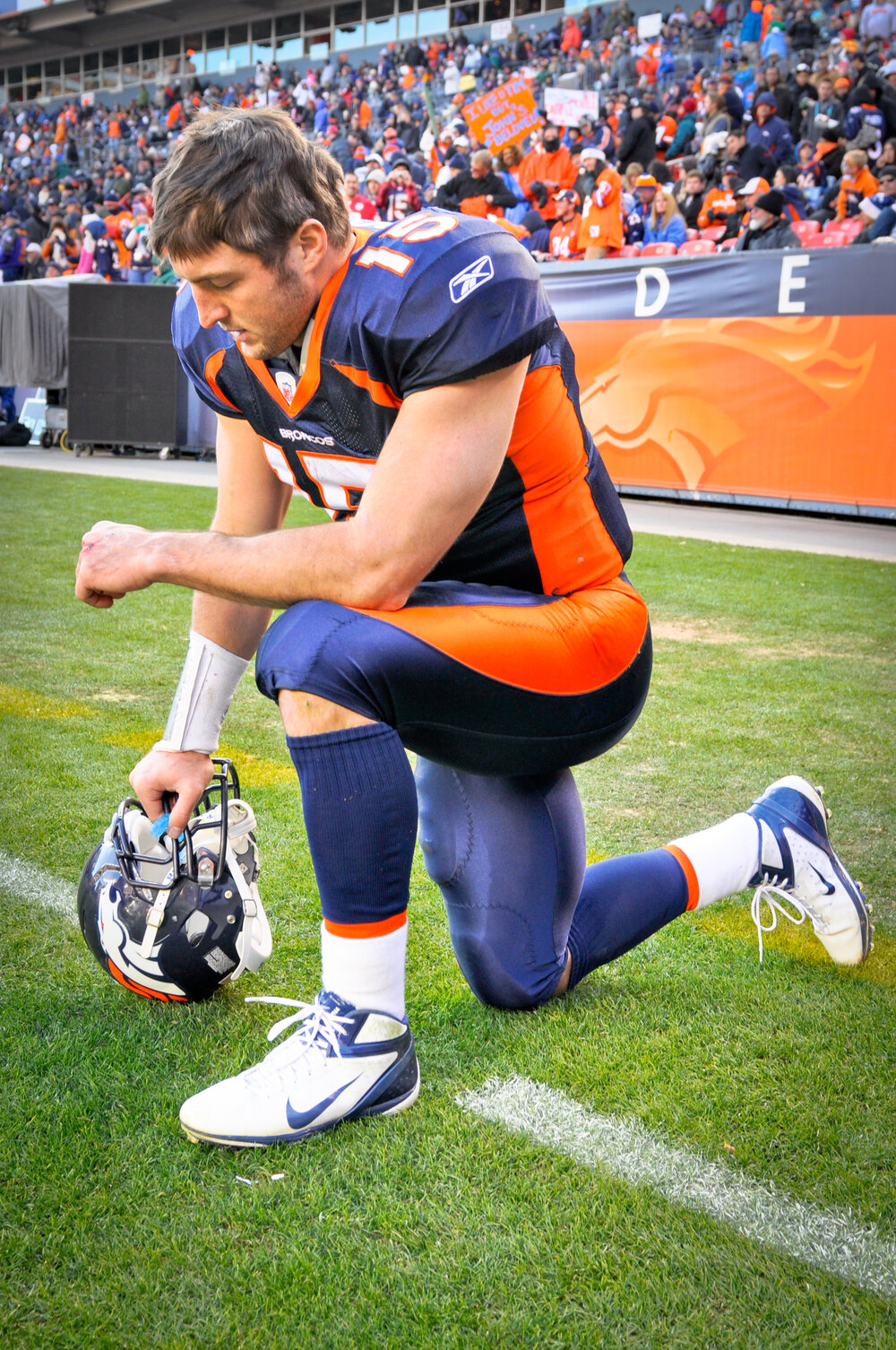
Tim Tebow, The Christian Comeback Kid

Tim Tebow is heading back to his primary sport, returning once again to the days of being a professional player in the NFL, after a stint on another field.

Back in the day when his NFL career appeared to be over, rather than leave professional sports behind, the versatile Tebow turned to the game of baseball. In 2016 he signed a minor league contract with the New York Mets, handling the positions of left field and designated hitter until retiring in February of 2021.

Now the Jacksonville Jaguars have signed the former Heisman Trophy winner to a one-year contract, with the understanding that he will switch positions from quarterback to tight end. The same day the Jaguars made the announcement, Tebow was spotted on the practice field wearing a No. 85 Jacksonville jersey, a truly unexpected sight for a whole lot of folks.

The sports star had plenty of detractors in the past, and unfortunately the menacing trend continues to this day. As a bona fide celebrity phenom, his solid beliefs on religious, cultural, and moral issues have resulted in him becoming a target for those with opposing viewpoints.

Acknowledged for being outspoken regarding his Christian faith, Tebow has publicly expressed strong pro-life convictions and has also openly advocated for faith-based abstinence.

He has been fearless in stating that he has lived his life in a way that is almost unheard of in today’s celebrity vortex, exercising restraint and maintaining self-control when it comes to the ways of the world.

It turns out he became very well known for engaging in a unique prayer practice, which routinely takes place right out on the playing field. Kneeling on one knee, he bows his head and rests his arm on one bent leg. The form of prayer expression ultimately reached fame status as “Tebowing” and was even included as a feature in a Madden NFL video game.

In terms of prior regular NFL seasons, Tebow spent his first two with the Denver Broncos and additionally made two starts for the New York Jets. He primarily played one position, that being quarterback, during his entire professional football career.

As Tebow’s detractors like to point out, he hasn’t played a down of professional football since the 2015 pre-season with the Philadelphia Eagles.

In relation to his current newfound position, he already has a relationship with Jacksonville head coach Urban Meyer, who was his coach at the University of Florida, where he was the first college sophomore ever to win the Heisman.

Friends of Tebow say that he is enthusiastic about attempting to make it back on the field in a new position at the highest level of play for any football player. He said in a statement via a team release, “I want to thank the Jaguars for the opportunity to compete and earn the chance to be part of this team. I know it will be a challenge, but it is a challenge I embrace.”

So how can a guy who has not played in a regular season NFL game since 2012, had only one snap as a receiver, and is about to turn a relatively mature 34, still have the confidence to embrace the challenge in an NFL comeback as a tight end?

The answer is in Tebow’s heart. He appears to have a type of celestial advantage when it comes to his athletic pursuits, which is most likely attributed to his ironclad faith-based attitude and irrepressible work ethic.

Fans in Denver remember that back in 2011, when he became the Bronco’s full-time starting quarterback, an amazing metamorphosis of the team seemed to miraculously take place. Tebow was able to transform a 1-4 Broncos team into a genuine contender, with seven wins in eight starts.

Sports journalists were awed by the then-quarterback’s unexpected late-game turnarounds, where the Tebow-led team often came from behind late in the fourth quarter. The Broncos, with Tebow as the QB starter, won their first playoff game in years and managed to snag the AFC West title as well.

Tebow has always had a knack for leadership, inspiring his teammates to work together to achieve. He also consistently remembers at post game interviews to thank his “Lord and Savior Jesus Christ,” never seeming to flinch as the harsh backlash inevitably follows.

He continues to be a voice of encouragement for people of faith everywhere. One sterling example is a sort of mini-sermon that Tebow delivered in April of 2020, in which he used his Instagram account to touch upon the subject of player trades and compare the practice to what he referred to as “the greatest trade in the history of the world.”

What is the trade? The old you for the new.

And why does he consider the trade to be the ultimate one? He says it in a way that only a Christian who is running the race can.

Tebow muses aloud, “Why is this the greatest trade? You need to understand this, so you can understand the old versus the new. Do you know what the old is? Sin, dead, darkness, bondage, separation, lost, baggage. Do you know what the new is? Righteousness, alive, light, freedom, united in Christ, found, child of God, purpose, son, daughter, home in heaven, paid for. That’s what the new is.”

A trade worthy of anyone’s consideration.

How God Saved the Life of Alice Cooper

Alice Cooper, known prior to his fame days as Vincent Damon Furnier, credits his faith in Jesus Christ, along with his daily scripture readings, for freeing him from the vice-grip of alcoholism.

Cooper’s public religious professions convey an especially hopeful and deeply moving message to those who find themselves facing the same life circumstances or those of a parallel nature.

The iconic singer and songwriter is frequently referred to by music critics and pop culture aficionados as “The Godfather of Shock Rock.”

Known for his elaborate goth-tinged stage shows, Cooper’s Hollywood persona stands in stark contrast to his present day personal life. He is a devout family man who has been married to his bride Sheryl Goddard for four and a half decades. The couple has three beautiful daughters together.

The name “Alice Cooper” was originally used by a rock band, which came to fame in the 1960s. After the band broke up in 1975, the name had become so closely associated with Furnier as an individual, he began using the band’s moniker as his stage name as well as his legal name.

Having initially dubbed themselves “Nazz,” the band members discovered that another successful music group, headed by rock icon Todd Rundgren, were already using the same name. The group subsequently chose “Alice Cooper” as its new brand.

Following an audition in front of another rock music legend, Frank Zappa, the group was signed to Zappa’s new record label, Straight Records.

An interesting pop culture anecdote. The Alice Cooper band experienced an exponential surge in its trajectory at one pivotal point, due to an unusual spontaneous event that was actually severely misreported at the time by the press. The occurrence took on the apt label of “The Chicken Incident.”

In September of 1969, while the Toronto Rock and Roll Revival was raging on, a live chicken somehow managed to make its way onto the stage. The bird proceeded to nestle into a feather pillow that Cooper used during his performances.

With little familiarity or experience with farm animals, and making an assumption that chickens could fly, Cooper threw the bird up and over the heads of the crowd. Instead of flying off into the distance, the chicken fell beak first flat onto the front rows of attendees, who reportedly mishandled the poor bird and unfortunately precipitated its untimely demise.

The following morning an embellished version of the story appeared on the front pages of newspapers all over the world, where it was reported that the frontman of the band had bitten the head off of the chicken and had even drank its blood.

Zappa had become aware of the media coverage and called Cooper to ask him about the veracity of the story. When Zappa was told the details, he reportedly said, “Well, whatever you do, don’t tell anyone you didn’t do it.”

The news quickly spread and became part of the Cooper legend, which cemented the notion that he was the originator of the “shock rock” genre.

It was in the early 1980s, following a period of denial, that Cooper would come to realize that his alcohol addiction was endangering his life. Like so many other public figures who have wrestled with alcohol addiction, the rocker was able to hide his substance abuse from the public. However, as he recently described to the New York Post, it was on one crucial day that he came to the understanding his alcohol use had taken a severe toll on his body.

“I woke up one morning and I threw up blood and that’s how I kind of knew it was over. My wife grabbed my ear and said, ‘Hey, the party’s over,’” Cooper revealed.

He reminisced three years ago with the New York Daily News about this critical time in his life, saying, “Everything that could go wrong was shutting down inside of me, I was drinking with Jim Morrison and Jimi Hendrix and trying to keep up with Keith Moon and they all died at 27.”

After completing rehab, Cooper was amazed to discover that the intense craving for alcohol he had lived with before had vanished. It was a miraculous occurrence that had graced his life, and he gives full credit for his mended state to the Lord of the Universe.

“Even the doctor said, ‘This is an absolute miracle.’ I said, ‘Why?’ They said, ‘Well, you should be hiding bottles all over the house and you should be sneaking drugs.’ I said, ‘I have absolutely no desire for that at all,’” Cooper told the Post.

“Everyone said, ‘Oh you have such great willpower.’ I said, ‘No, God has great willpower. He took it from me.’ My dad was a pastor, my grandad was a pastor, Sheryl’s dad was a pastor. I had such strong prayer for me,” Cooper shared.

People are continually awestruck by the same book that Cooper reads each day. The Holy Scripture describes numerous unlikely figures that God chooses over time to fulfill his divine plans.

And so it seems fitting, within a supernatural context, that an individual who has been immersed in a secular shock rock world can be brought to a place where he can lift up others.

After God secured a victory for him over his addiction, Cooper seems to have been anointed as a kind of adjunct lay minister of the music industry. He now provides help and counsel to other rock musicians who struggle with substance abuse issues, often answering calls in the dark of night from those in need.

Much like the relatability and candor of his song lyrics, the rocker describes his religious faith in a way in which others can freely accept.

Christianity, according to Cooper, merely “has to do with a one-on-one relationship with Jesus Christ.”

The Who’s Roger Daltrey Schools the ‘Woke’ Generation

Roger Daltrey is the lead singer of the rock group The Who.

The iconic 1960s band played a starring role in music history as part of an era that pop culture designates as “The British Invasion.”

Artists, experts, and sages within and without the music industry consider The Who to be one of the most influential rock bands of the 20th century, both for having brought a number of innovations to the rock music world and for having racked up sales of over 100 million records worldwide.

Daltrey was, and still remains, the prototypical rock front man, a consummate showman who perfected the lasso swing of the microphone accompanied by the boldly executed strut.

Counted among its rock music accomplishments is the addition of a number of enduring classic tunes to the pop culture catalogue, including “Won’t Get Fooled Again,” “I Can See For Miles,” and “My Generation,” and the popularization of the “rock opera” in its musical theater pieces “Tommy” and “Quadrophenia.”

The song that initially propelled The Who to musical fame was “My Generation.” On Rolling Stone’s list of the 500 Greatest Songs of All Time, it clocked in at number eleven.

During an interview on Zane Lowe’s Apple Music 1 podcast, Daltrey did some thinking out loud about his generation and the creative freedom that was enjoyed during the 1960s. He remarked that the “woke generation” is creating a “miserable world” that suppresses the kind of free expression he and his band mates experienced in their heyday.

“It’s terrifying, the miserable world they’re going to create for themselves. I mean, anyone who’s lived a life and you see what they’re doing, you just know that it’s a route to nowhere,” Daltrey said.

He spoke of the blessings that he experienced by having lived in a “golden era” when freedom of speech was encouraged rather than stifled.

Daltrey and the band used creative artistic freedom to establish a brand that combined rock music with modern performance art. Members ended their concerts in dramatic fashion by destroying their own instruments right on the stage. For better or for worse, depending on your pop culture perspective, copycats followed.

With all the fame and fortune he has achieved, Daltrey appears to be solidly grounded, genuinely grateful, and amazingly humble, commenting that “… when you’ve lived through the periods of a life that we’ve had the privilege to. I mean, we’ve had the golden era. There’s no doubt about that.”

The rocker pointed out the shortcomings of today’s social media and its effect on the integrity of information.

“It’s just getting harder to disseminate the truth. It’s almost like, now we should turn the whole thing off. Go back to newsprint, go back to word of mouth and start to read books again. It’s becoming so absurd now with AI, all the tricks it can do, and the ‘woke’ generation,” he opined.

Unflinchingly, he also took on the system that seems to have recently become much more acceptable in Western nations than it has ever been in the past – communism.

“… We came out of a war, we came out of a leveled society, completely flattened bomb sites and everything. And we’ve been through socialist governments. We’ve seen the communist system fail in the Soviet Union. I’ve been in those communist countries while they were communist,” Daltrey explained.

With a dose of sarcasm tacked onto his remark, Daltrey talked about the tragic results of communist regimes, saying, “I’ve seen how ‘wonderful’… really? it was.”

His message to the “woke” is that socialism and communism are far less than “wonderful” for the lives of those who are subject to such systems.

It comes as no great surprise that Daltrey handily plays the role of verbal pugilist. As a younger man he was known to engage a time or two in brawls of the physical kind.

Like his band mates, he grew up in a tough British working class neighborhood. He was once fired from The Who for punching out Keith Moon over the drummer’s substance abuse. However, the band reconciled with their irreplaceable front man rather quickly.

In a later additional “Rocky”-style encounter, Daltrey knocked out his legendary guitarist Pete Townsend during a physical altercation the two had.

On the political front, in the past he was a supporter of the British Labour Party but became disillusioned with the party’s mass immigration policies under the Tony Blair government.

In 2018, he telegraphed his sensitization to socialist policies when he referred to the Labour leader at the time, Jeremy Corbyn, as a “communist.”

He also supported the Brexit movement, writing the following in the UK Mirror:

“Whatever happens our country should never fear the consequences of leaving. We went into the Common Market in 1973. Do you know what was going on before we went in? It was the 1960s. The most exciting time ever – Britain was Swinging. Films, Theatre, Fashion, Art and Music… Britain was the centre of the world. You got that because Britain was doing its own thing. It was independent. Not sure we’ll ever get that again when we’re ruled by bureaucrats in the European Union.”

It takes someone like Daltrey who, along with the courage, has the career clout as a rock icon to express himself in a manner that risks cancellation by the very folks he is criticizing.

As for The Who, after releasing 11 studio albums the group unveiled yet another one in December of 2019, fittingly called “WHO.”

Nineteen States Take the EPA to the Supreme Court

A recent appeals court ruling granted the Environmental Protection Agency (EPA) authority to control energy consumption across the country.

As a result, nineteen states are now attempting to limit the EPA’s authority via court action.

West Virginia Attorney General Patrick Morrisey is representing his own state as well as leading a group of attorneys general from the states of Alabama, Alaska, Arkansas, Georgia, Indiana, Kansas, Louisiana, Missouri, Montana, Nebraska, Ohio, Oklahoma, South Carolina, South Dakota, Texas, Utah, and Wyoming, and the governor of Mississippi has also signed on.

The 19-state coalition is asking the U.S. Supreme Court to reverse an appeals court ruling that gave the EPA the unprecedented authority.

Morrisey contends that if the ruling from the U.S. Court of Appeals for the District of Columbia Circuit were left in place, the EPA would have “virtually unlimited authority to regulate wide swaths of everyday life with rules that would devastate coal mining, increase energy costs and eliminate countless jobs.” (https://wvrecord.com/stories/593830432-morrisey-leads-19-state-petition-urging-supreme-court-to-limit-epa-authority)

More specifically, the documents filed by the coalition of states assert that the lower court misinterpreted Section 111 of the Clean Air Act, granting to the EPA the ability to exercise overly broad powers to radically transform the nation’s energy grid and force states to fundamentally alter their energy sources.

The transformation would be accomplished without any legislative input from Congress, allowing the federal agency to alter virtually any and all sectors of the economy, including factories, power plants, small businesses, and residential housing, with coal mining and natural gas production being placed in jeopardy.

The coalition argues that if the High Court were to delay a review, this would likely lead to even more significant and irreparable damage while simultaneously forcing states to invest time and resources into uncertain enterprises.

Back in 2015, Morrisey had filed a lawsuit against the Obama administration over a policy that sought to severely cut carbon emissions, alleging that the implementation of such a policy exceeded the EPA’s mandate.

Morrisey’s legal actions resulted in the Supreme Court issuing a stay, which prevented the policy from being rolled out. However, the D.C. Circuit Court vacated the ruling, thus opening the door for the incoming administration to implement even wider-reaching carbon reduction policies.

The petition of Morrisey and the other attorneys general alleges that the appeals court ignored the rationale for the Supreme Court stay.

The new petition comes as the current administration has announced the most excessive climate initiatives in history, with an intended goal of cutting U.S. carbon emissions in half by the year 2030 and ultimately reaching zero carbon emissions by 2035.

Morrisey spoke against the White House target goals, arguing that the change would have a negative economic impact that would be detrimental to our nation’s international energy standing and calling the emissions cut “a self-inflicted wound to our economy and our national security.” (https://ago.wv.gov/Documents/Statement%20of%20West%20Virginia%20Patrick%20Morrisey%20on%20President%20Biden’s%20Climate%20Plan.pdf)

Critics of the administration’s aggressive carbon reduction plans point out that China and other major polluters will continue to increase their emissions, which will presumably undercut any carbon reductions by the U.S., while at the same time increasing electricity and energy costs for all Americans.

Critics also voice concerns for the segments of our country that rely on fossil fuels and related industries, asserting that these areas would be disproportionately affected by such severe reductions.

If West Virginia’s top law enforcement official and the attorneys general from the coalition of states are successful in convincing the Supreme Court to accept the case, our nation’s people will witness the biggest legal battle involving climate change policy that has occurred in over a decade.

This is the kind of court proceeding that will potentially expose the judicial philosophy of each of the justices on the Supreme Court.

It will also likely define the judicial branch itself and, in the end, determine whether our nation takes the road not traveled.