Filmgoers Ignore Detractors and Flock to ‘Sound of Freedom’

Despite Hollywood executives trying to shelve it and mainstream media outlets trying to discredit it, the recently released film “Sound of Freedom” has upended the entertainment industry with resounding ticket sales, an enviable profit margin, and superb audience ratings.

The Washington Post, the Rolling Stone, the UK Guardian and other media organizations have denigrated the movie, falsely attempting to tie it to conspiracy theorists.

People are simply ignoring media naysayers, packing the theaters, and showering the film with standing ovations, resulting in more than $40 million in box-office revenue over a six-day period, according to industry estimates.

Due to its summer release, the movie had been facing plenty of competition, which was coming from big-budget studio blockbusters intended to please popcorn loving crowds.

“Sound of Freedom” definitely doesn’t conform to the template of a conventional summer release.

The plot of the movie is based on the true story of Tim Ballard, who founded a group to combat child sex trafficking.

Jim Caviezel, star of Mel Gibson’s 2004 cinematic masterpiece “The Passion of the Christ,” takes on the role of Ballard, a former government agent who stares down danger as he travels to godforsaken places on a quest to rescue enslaved children who have become victims of unspeakably horrifying crimes.

Summer studio releases typically have budgets that consist of hundreds of millions of dollars. However, with a tab of $14.5 million “Sound of Freedom”’s production costs were considerably less.

On the Fourth of July, “Sound of Freedom” easily passed up the franchise studio sequel “Indiana Jones and the Dial of Destiny.” The film had a release-day revenue of $14 million as compared to the $11.5 million that the “Indiana Jones” movie took in on its June 30 opening.

“Indiana Jones and the Dial of Destiny” had a budget of more than $250 million, while “Sound of Freedom” cost less than $15 million.

“Sound of Freedom” hit a very solid third place for the weekend with more than $18 million.

The public loves the film, giving it the highest CinemaScore rating possible, an A+. And movie fans who weighed-in on the Rotten Tomatoes website gave it a 100% rating.

In order to get more people to pay attention to the violations of human dignity with which the film deals, Dana White, President of the Ultimate Fighting Championship (the global mixed martial arts organization) posted a video on social media.

White spoke out on the importance of “Sound of Freedom” and the chilling nightmare of human trafficking. He was joined by legendary actor and director Gibson, who urged people to see the movie.

The White and Gibson video footage has gone viral, providing some powerful promotion for the movie.

During the video, White said, “There is a new movie out there called ‘Sound of Freedom’ and it’s about human trafficking. More importantly, about the trafficking of children. This is a disgusting, horrific issue that’s happening all around the world. And it’s not getting better, it’s getting worse.”

The UFC CEO is utilizing his own company in an effort to get the word out.

“What I’m gonna do is I’m gonna give any of my UFC employees that want to see this movie free tickets to go and see,” White said.

He even urged other business leaders to take his idea and run with it.

“I would like to encourage other executives to do the same at their company,” he said.

In the section of footage in which he appears, Gibson focused on the public becoming more knowledgeable on the issue.

“One of the most disturbing problems in the world today is human trafficking,” Gibson said.

“Particularly the trafficking of children. Now the first step in eradicating this crime is awareness. Go see ‘Sound of Freedom,’” he encouraged.

In a unique approach to ticket sales, at the end of the movie while the credits roll on, Caviezel appears onscreen to ask the audience to go to the Angel Studios website and participate in the “Pay It Forward” program.

This program allows people to purchase tickets for others so that those who cannot afford the cost will be able to obtain a ticket for free.

Those who suffer from the scourge of human trafficking are crying out to be rescued.

May “Sound of Freedom” succeed in its mission of informing people and prompting action.

And may all of us be responsive to those who wait in the shadows for someone to care.

‘Sound of Freedom’ Is the Whisper of Hope

Some things are so horrible they are difficult to even mention. Sex trafficking of children is one such unspeakable issue.

However, a recent movie not only dares to breach the subject, it brings a ray a hope to the darkest of places.

People of conscience uniformly agree that the abduction of little ones for the purposes of sexual exploitation is an abomination. It is the slavery of the modern day.

Traffickers seek out the vulnerable, those unfortunate youth who frequently live in poverty or war-torn regions of the world.

Victims such as these are being illegally sold, adopted out, married off, pushed into prostitution, and/or forced to work under myriad of insufferable and degrading conditions.

A newly released film titled “Sound of Freedom” is taking this unmentionable issue head-on.

The movie is directed and co-written by Alejandro Monteverde, produced by Eduardo Verastegui who also appears in the film, and stars Jim Caviezel, well known as the lead actor in Mel Gibson’s “The Passion of the Christ” film, and Mira Sorvino, the Oscar winning actress in Woody Allen’s “Mighty Aphrodite” film.

Caviezel portrays hero Tim Ballard, who left his previous real-life position as an agent with Homeland Security Investigations to pursue a mission of rescuing children from human sex traffickers.

Ballard personally requested that he be portrayed in the film by Caviezel, having observed the actor’s work in the 2002 film “The Count of Monte Cristo.”

The movie tells the true story of Ballard’s dangerous journey abroad to rescue the sister of a boy he had previously saved from traffickers.

The film’s opener contains some compelling scenes that demonstrate one of the diabolical ways in which traffickers abduct children.

A welder who is living in Honduras encounters an elegant woman who claims to be the founder of a talent agency. After seeing the welder’s 11-year-old daughter singing at the marketplace, the woman suggests that she tryout for a potential job in the entertainment business.

The father subsequently drops both his daughter and son off at the tryouts, which are being held at a poorly maintained hotel and are attended by other children as well.

When the father returns to pick up his children, to his shock he finds that the room is empty and his daughter and son are missing.

It turns out that the woman was no recruiter for the entertainment business but instead was a front for the fast-growing criminal enterprise of child sex trafficking.

Ballard is able to engineer a daring rescue of the welder’s son. However, his sister continues to be held captive. So Ballard heads to Colombia to try and rescue the young girl from the clutches of evil.

The backstory of the “Sound of Freedom”’s release is a tale of providential determination. After the project’s original filming and completion in 2018, it takes a detour that almost completely derails it.

21st Century Fox had contracted to distribute the movie, but before it can be scheduled for release the studio is acquired by Disney.

For some reason Disney executives choose to shelve the film. It takes years for the filmmakers to re-acquire the distribution rights.

In March of 2023, Angel Studios (the faith-based entertainment company which through crowdfunding has produced “The Chosen,” “Dry Bar Comedy,” and “The Wingfeather Saga”) was able to obtain the distribution rights for “Sound of Freedom” from Disney.

Angel Studios used its equity crowdfunding expertise to raise the cash needed to market the movie.

The studio also utilized an innovative program that encouraged patrons to “pay it forward,” so that people who might not otherwise see the movie would be able to watch it in theaters for free.

Goya Foods, an executive producer of the film, also provided financial support for the movie via Goya Cares, an anti-trafficking foundation established by the company.

The marketing efforts for the film really appear to be paying off and have resulted in more than $7 million in pre-sale revenue.

During one of the many dramatic scenes in the film, Ballard alludes to a passage from the Gospel of Luke.

“It would be better for you if a millstone were hung around your neck and you were thrown into the sea than you should ever hurt one of these little ones,” Ballard says.

In the Bible, Jesus himself instructs us about the inherent value of each and every child.

When in the film Ballard is asked why he has taken up this arduous mission, he replies, “Because God’s children are not for sale.”

So strong is his commitment to his mission, during the filming of the movie Ballard reportedly left the Columbian set so that he could join his team of former Navy SEALs to participate in the rescue of more than 200 children.

For me personally, another passage from the Bible comes to mind. It is that of the Good Shepherd.

The shepherd has 100 sheep in his flock. But if one single sheep goes missing, he leaves the 99 in search of the one.

At least in prayer, may people of conscience continue to strive to be like the Good Shepherd.

And may God in his goodness send more Tim Ballards to rescue the one in need.

AI and the Song

Music is a universal language like no other.

When words seem inadequate, it speaks volumes.

So where does music come from?

We may differ in our opinions on that. But a lot of us believe that inspiration, in music as in various other art forms, literary writings, discoveries, inventions, and the like, has an other worldly origin.

Musical inspiration is particularly unique, though, because of its biblical roots and its distinct resonance within human beings across all time.

Artists who are driven to share their musical inspirations are currently facing some questions that are seriously haunting ones.

Here are a few:

1. Can technology really create the equivalent of human music?

2. Will technologically designed songs measure up to the music that human beings love?

3. Is music designed by technology really music?

There are a whole lot of music artists who are concerned about Artificial Intelligence (AI) and its supposed “creation” of musical content.

Experimentation with computers composing music has been going on for decades. But there was always a human at the helm.

Now with AI, the human is hidden. A programmer, a series of programmers, faceless, nameless, all seemingly lost, only data remain.

And we are supposed to accept the notion that data have been assigned to be our new composers?

Such so-called artistic advances in AI are prompting an interesting reaction – a mixed blend of enthusiasm, anticipation, and alarm.

A few recent examples provide insight.

A “collaboration” between famed pop musicians Drake and The Weeknd, which was actually an AI-simulated version of “Heart on My Sleeve,” went viral on social media. The track was quickly pulled at the behest of the label, Universal Music Group.

AI was used to generate an album of the highly successful British rock band Oasis. But the group had long been disbanded. Apparently, an insignificant detail.

Canadian EDM artist Claire Boucher, a.k.a. Grimes, is evidently embracing the idea of an AI version of herself.

She sent out the following advertisement of sorts:

“I’ll split 50% royalties on any successful AI generated song that uses my voice,” Grimes tweeted. “Same deal as I would with any artist i collab with. Feel free to use my voice without penalty. I have no label and no legal bindings.”

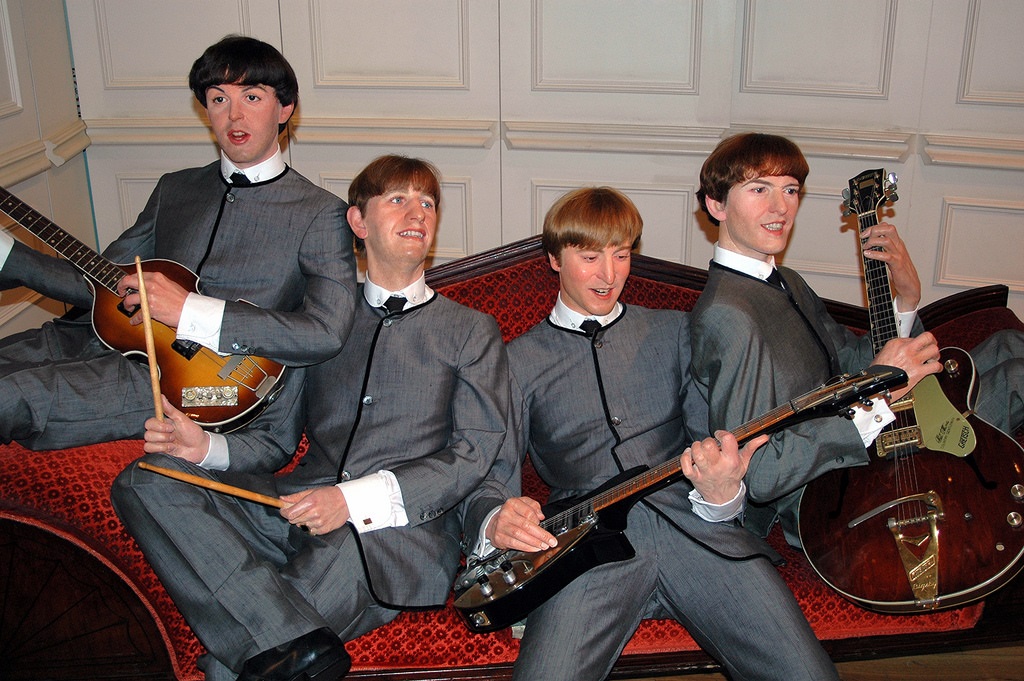
Probably the biggest story relating to all of the above involves Sir Paul McCartney. The former Beatle is one of the most influential composers and performers of all time.

McCartney has accelerated the AI discussion by announcing that the surviving Beatles would release an AI-assisted tune, which will feature vocals by the late John Lennon.

He told BBC Radio 4 that the technology was able to “extricate” Lennon’s voice from a demo recording to allow the song to be completed, and it is set to be released this year.

During the production of Peter Jackson’s documentary “Get Back,” technology was used to remove background noise from the track and otherwise clean up the audio.

“[Jackson] was able to extricate John’s voice from a ropey little bit of cassette,” McCartney said. “We had John’s voice and a piano and he [Jackson] could separate them with AI.”

“So when we came to make what will be the last Beatles record, it was a demo that John had, and we were able to take John’s voice and get it pure through this AI,” McCartney added.

Reportedly, the song is a 1978 Lennon composition called “Now and Then.”

McCartney had received the demo a year earlier from Lennon’s widow, Yoko Ono. The tracks were recorded on a boombox as John sat at the piano in his New York apartment.

Two of the songs on the demo, “Free as a Bird” and “Real Love,” were restored by producer Jeff Lynne and released in 1995 and 1996, the first Beatles release in 25 years.

The band had attempted to record “Now and Then,” but the recording session had been halted and the tune abandoned.

Now AI is facilitating McCartney’s completion of the song.

But is it really a new Beatles song? John isn’t with us anymore. How could it be?

After the announcement, some consternation appeared on various web platforms.

McCartney then backtracked a bit, taking to Twitter to assure Beatle fans that in the making of the “new” Beatles song nothing had been “artificially or synthetically created.”

It could be that McCartney is experiencing some trepidation about the use of AI for music production.

He’s certainly not alone.

According to a poll taken by the Bedroom Producers Blog, 86% of those surveyed believe the technology will replace existing tools of music production, and 73% of respondents believe AI could replace human producers in the future.

It actually doesn’t take a musician or songwriter or producer or engineer to realize that, within this context, AI is just what its name indicates – Artificial.

Thankfully, there are still those among us who are able to recognize real music and who freely acknowledge the very source of our human inspiration.

AI Plays God

Certain writings have always been considered sacred.

Such writings are, always have been, and always will be revered and treasured by the people who view them as foundational to their core spiritual beliefs.

Many of those who adhere to Judeo-Christian religious tradition consider the Holy Scriptures to be the epitome of such sacred writings. Furthermore, it is resolutely held by adherents that the writings originate from God himself.

The Jewish people have traditionally maintained a respect for scripture, displaying a reverence so deep that they have seen fit to place the Torah, i.e., the five books of Moses, in a carefully constructed ark.

Whenever the Torah is taken out of the ark and exhibited in the synagogue, veneration is offered and the entire congregation stands for the duration of the devotion.

Christians likewise regard the Bible as a supremely sacred text. Christian liturgies feature ceremonial readings of passages from scripture, and the Christian faith upholds the Bible as the Word of God.

If someone were to propose a fundamental alteration of the aforementioned sacred writings, it would be extremely disturbing and highly offensive to members of religious congregations.

As it turns out someone has done just that; proposed a fundamental alteration of the Holy Scriptures.

Yuval Noah Harari, a contributor and advisor to the World Economic Forum, is pushing a new global bible, one that would purportedly be AI-generated.

When Harari was being interviewed by journalist Pedro Pinto in Lisbon, Portugal, he touted AI as different from all other technologies, because, in his words, it is “the first technology ever that can create new ideas.”

Harari went on to compare and contrast AI with an age-old innovation, saying, “The Gutenberg printing press printed as many Bibles as it was ordered to do. But it could not write a single new page.”

He added, “AI can do that. It can even write a new Bible.”

“In a few years, there may be religions that are actually correct,” he opined.

What he meant by “correct” is left to the imagination.

In any event, he seemed to be attempting to describe a socially acceptable scripture that would be suitable for a supposed one world religion.

He asserted that “throughout history, religions dreamed about having a book written by a superhuman intelligence, by a non-human entity.”

It goes without saying that people of faith already know the authentic non-AI Bible already has a supreme author who is far beyond human.

Harari has made it perfectly clear that he is no fan of the Bible or of its adherents.

In an interview with Google, he disparaged Christian beliefs, including the pinnacle belief of the Resurrection of Jesus, which he proceeded to characterize as “fake news.”

A few years ago Harari wrote a commentary in The Globe and Mail that was derisive of the Bible.

“Centuries ago, millions of Christians locked themselves inside a self-reinforcing mythological bubble, never daring to question the factual veracity of the Bible…,” he wrote.

He again linked faith-based beliefs to “fake news.”

“I am aware that many people might be upset by my equating religion with fake news, but that’s exactly the point. When 1,000 people believe some made-up story for one month, that’s fake news. When a billion people believe it for 1,000 years, that’s a religion…”

He belittled those who view the Bible as sacred, stating that “billions of people have believed in these stories for thousands of years. Some fake news lasts forever.”

In a column for the British newspaper The Guardian, Harari blamed the Bible for environmental problems.

“It’s possible to trace a direct line from the Genesis decree of ‘fill the earth and subdue it…’ to the Industrial Revolution and today’s ecological crisis,” he wrote.

In the very book that Harari disparages, the words of Holy Scripture warn about those who view themselves as God.

Google co-founder Larry Page once shared with Elon Musk that he hoped to build an AI super-intelligence that would be a “digital god.”

Many elites see AI as a path to becoming godlike.

The advent of a super-intelligence, which would exceed present human intellectual capacity, would evidently be heralded by Harari and many other globalists as a defining moment.

Harari envisions the future of humanity as containing people who become new types of beings infused with a supposed technologically superior intellect.

He explained that individuals such as these would be “almost like gods.”

The key word in Harari’s musings is almost.

Pray that he doesn’t have to find out the hard way that there is, always has been, and always will be one true God.

AI Is Set to Take Over Hollywood

Generative AI is a type of Artificial Intelligence technology that has the capacity to almost instantly produce text, images, audio, and video.

Understandably, the entertainment community is in an uproar over the prospect of AI wiping out a huge chunk of the longstanding industry.

While a segment of Hollywood is actually enthused about the idea that AI might free creators from some of the typically tiresome tasks and also help to avoid the hefty price tag that frequently accompanies big budget projects, others are scared to pieces.

It’s fairly easy to convince a portion of the entertainment community that AI is an overall plus. Use of the technology has become common practice within the biz.

The late Carrie Fisher was digitally cast via AI (with permission from her daughter) in the film “The Rise of Skywalker.”

In another instance, in order to make it seem as if 80-year-old actor Harrison Ford were still in his thirties, Disney-owned Lucasfilm used images of Ford’s face, taken from the “Indiana Jones” films of the 1980s, and blended them into the fifth Indiana Jones film, “Indiana Jones and the Dial of Destiny.”

During an interview with late-night host Stephen Colbert in which he talked about his AI-restored on-screen image, Ford said, “It’s fantastic.”

Actor James Earl Jones, who is now 92 years old, authorized an AI version of his famous voice, which he had supplied for the Darth Vader character in the “Star Wars” franchise series, so that the character could continue on.

Reportedly, a digital version of the late actor Christopher Reeve will be included in a cameo appearance in the upcoming movie “The Flash.”

AI technology is routinely being used to alter mouth movements, so as to more accurately sync words in dubbed films of a different language. It is also regularly being used to create cinematic music and soundscapes.

Paul Schrader, screenwriter of “Taxi Driver” and director of “American Gigolo,” did a Facebook post about something that he called a “dirty little secret composers know.”

“AI is already scoring filmed entertainment and has been for some time,” Schrader wrote.

Lately the actors and writers unions have been forced to confront the dark side of AI, and they don’t like what they see coming.

Generative AI is one of the main reasons the Writers Guild of America (WGA) has been on strike for weeks and the Screen Actors Guild‐American Federation of Television and Radio Artists (SAG-AFTRA), of which this author is a member, has been threatening to strike as well.

Both unions are seeking to limit the use of AI in the industry.

Digital doppelgangers in fake movie trailers have been popping up, making entertainment content without the assistance of Hollywood creatives.

AI-generated trailers, which have appeared on the Internet for what seems to be director Wes Anderson’s films, typically include well known actors such as Bill Murray and Scarlett Johansson. The trailers implement Anderson’s characteristic style, and they feature fake adaptations of popular franchises such as “Star Wars,” “Harry Potter,” and “The Lord of the Rings.”

A video of Ryan Reynolds selling Teslas was recently shared on Twitter but has since been removed. Reynolds’s production company responded with another AI-generated video, with Twitter owner Elon Musk endorsing gin made by a Reynolds-owned company. This video has also been removed.

A-listers, including Tom Cruise and Keanu Reeves, have actually been the victims of unauthorized AI-generated deep fake videos.

Then there’s the world of voice actors, which has also been shaken in a major way. So-called voice cloning is easily conjured up by AI technology.

The reality is AI technology is capable of improving itself. The phenomenon is known as “emergence.” In the not-too-distant future, entertainment content will be created by simply giving prompts to AI technology without actors, writers, directors, or cameras having to be involved.

This means that an individual with minimal resources but with access to AI can create professional looking videos that feature famous actors and characters, minus their personal consent or involvement.

Actors already have a degree of legal protection, through existing prohibitions, from unauthorized use of their names, images, and/or likenesses.

However, things start getting really murky when it comes to AI technology’s training data. The rights of the previous performances of individual actors being used for the purposes of AI training will likely be an issue in union negotiations.

Duncan Crabtree-Ireland, SAG-AFTRA’s chief negotiator, has spoken out about maintaining control over the AI-created lookalikes of actors and the issue of fairness when it comes to using personas.

“The performer’s name, likeness, voice, persona – those are the performer’s stock and trade,” Crabtree-Ireland said. “It’s really not fair for companies to attempt to take advantage of that and not fairly compensate performers when they’re using their persona in that way.”

Writers in turn possess intellectual property rights to their works. But under the present law they will have a difficult burden to prove.

In order to protect their rights in court, they must prove that the AI work is either a reproduction of their own work or a derivative of it.

In the real world, AI will likely be trained with a multitude of scripts, making this burden of proof all but impossible.

In Schrader’s opinion, “The WGA position on AI is a fascinating conundrum. The guild doesn’t fear AI as much as it fears not getting paid.”

Notwithstanding the dangers that the technology poses, the director predicts that AI “will become a force in film entertainment.”

Both SAG-AFTRA and the WGA want reasonable safeguards before AI capabilities proliferate within the industry.

“Family Ties” actress, computer science graduate, and former SAG board member Justine Bateman is unequivocally against the use of AI tech for entertainment content.

“I think AI has no place in Hollywood at all. To me, tech should solve problems that humans have,” Bateman said, adding that its use will “have an incredibly bad effect — disastrous effect on the entertainment business.”

The actress views the use of AI as a backward looking “automatic imitation” through which creativity will be stifled.

“What’s the next genre in film? What’s the next genre in music? You’re never going to see anything like that if we’re all using AI,” Bateman said.

She stated that she didn’t “want to live in that world,” echoing the sentiments of many actors, writers, directors, and musicians.

FYI: The above written article was created by means of the author’s un-Artificial Intelligence.

Catholic Bigotry and the Los Angeles Dodgers

The Los Angeles Dodgers recently decided to re-invite a virulently anti-Catholicgroup to the team’s Pride Night event.

This is the same group that had originally been scheduled to receive a community service award but was uninvited for a brief period of time.

Sen. Marco Rubio, R-Fla., Catholic Vote, the Catholic League, and other Christian groups had condemned the original decision, and the team had promptly rescinded the invite.

However, the Los Angeles LGBT Center, the ACLU, several Democrat politicians, and the media began accusing the baseball team of bigotry.

In the midst of the uproar, the Los Angeles Angels baseball team issued a public invite of its own to the aforementioned anti-Catholicgroup.

That’s when the Dodgers re-invited the group and proceeded to issue an apology for having previously uninvited it.

It is puzzling at a minimum that both LA teams have endorsed a group that has a long history of being dedicated to anti-Catholic activities.

The Archdiocese of Los Angeles has weighed in, issuing a statement condemning the Dodgers for “the decision to honor a group that clearly mocks the Catholic faith and makes light of the sincere and holy vocations of our women religious who are an integral part of our Church,” adding that the invitation to the group “has caused disappointment, concern, anger, and dismay from our Catholic community.”

The LA Archdiocese further stated that it “stands against any actions that would disparage and diminish our Christian faith and those who dedicate their lives to Christ.”

The decision by the Dodgers also drew the ire of the Twitter account of San Francisco Archbishop Salvatore Cordileone.

“Our Catholic sisters devote themselves to serving others selflessly. Decent people would not mock & blaspheme them,” the archbishop tweeted. “So we now know what gods the Dodger admin worships. Open desecration & anti-Catholicism is not disqualifying. Disappointing but not surprising. Gird your loins.”

CatholicVote has vowed to launch a “barrage” of advertising against the team across Los Angeles and during game broadcasts.

“This is a slap in the face of every Catholic…and we will pummel this decision in advertising that the Dodgers can’t ignore,” CatholicVote President Brian Burch said in a statement.

“Every advertiser, every season ticket holder, every charity, every fan must speak out against the Dodgers’ decision to promote anti-Catholic hate,” Burch added.

He questioned why the Dodgers would honor a group that is, among other descriptives, clearly “anti-Catholic.”

This particular group has a fairly long history of mocking and insulting Catholic religious figures, tenets, and symbols. Antipathy toward Catholic Christians is routinely expressed both directly and indirectly.

The Catholic League has published a report citing numerous examples of bigotry against Catholicism in general and Catholic nuns in particular.

The list includes a sham exorcism, a sham Mass that blasphemes the Lord and Savior of Christianity, a sham Sacrament of Holy Communion, a sham vile version of the Stations of the Cross devotion, a sham mockery of the holy day of Good Friday, and a sham irreverent ridicule of Easter Sunday.

Although he is a professed Catholic, President Joe Biden has said nothing about the debacle.

Catholic League President Bill Donohue is seeking to convince Catholics in the Los Angeles area to skip the Pride Night event scheduled for June 16.

Unfortunately, like so many other things in life, America’s favorite pastime has been politicized.

In the 1992 movie “A League of Their Own,” Tom Hanks’s character Jimmy Dugan utters the famous line: “There’s no crying in baseball!”

Well, Jimmy, there’s crying in baseball today.

Paul Simon: The Psalmist and the Song

Paul Simon is one of the most celebrated contemporary artists in the history of American music. The acclaimed singer-songwriter has won sixteen Grammy Awards and is also a two-time inductee into the Rock and Roll Hall of Fame.

Simon’s decades-long musical journey had its beginnings in a pairing up with a schoolmate named Art Garfunkel. The two formed a duo, aptly named Simon & Garfunkel.

The combined efforts of the two generated a soundtrack that through melody and lyrics was able to capture and reflect back the thoughts and emotions of a nation in the midst of a cultural shift.

A musical pioneer, the group exquisitely melded the genres of folk and rock. Its success was remarkable as evidenced by massive record sales as well as accolades, including being ranked among Rolling Stone magazine’s “Greatest Duos of All Time.”

In his solo career, which launched in the 1970s, Simon would continue his eclectic musical and lyrical exploration, this time combining reggae, soul, and indigenous styles.

Simon’s dad Louis provided his son with an early musical head start. In addition to being a college professor, Louis was a bass player and bandleader, performing under the name Lee Sims. Mom Belle taught elementary school.

Simon’s latest work is a 33-minute suite, titled “7 Psalms.” The project came to the iconic poet-wordsmith in a compelling dream, which has evidently reshaped his life’s work.

Spiritual language and imagery has long been a trademark of his inimitable songwriting. Simon wrote the timeless inspirational hymn “Bridge over Troubled Water,” which he and Garfunkel performed to the adulation of audiences around the globe.

He is able to make his religious visions uniquely relatable, as he did in his 2012 album “So Beautiful or So What,” which was so filled with faith-based references it surprised even him. The song lyrics feature poetry about God, angels, creation, prayer, and the afterlife.

While discussing the spiritual nature of his art during an interview with the PBS program “Religion & Ethics NewsWeekly,” he noted that “for somebody who is not a religious person, God comes up a lot in my songs.”

“I think it’s a part of my thoughts on a fairly regular basis,” he said. “I think of it more as spiritual feeling. It’s something that I recognize in myself and that I enjoy, and I don’t quite understand it.”

Although his music is cherished by people of all faiths, he was actually raised in the Jewish tradition. Regarding his Jewish roots, he explains, “I was raised to a degree enough to be bar mitzvahed and have that much Jewish education…”

With fans of every spiritual persuasion, Christians appear to be especially appreciative for his Christmas song additions. In “So Beautiful or So What” he includes the Christmas tune “Getting Ready for Christmas Day.” In another song called “Love and Hard Times,” he includes the gentle line: “God and His only son paid a courtesy call on Earth one Sunday morning.”

In the song “The Afterlife,” he imagines waiting in a line similar to the Department of Motor Vehicles. But his poetic description of life after death is anything but ordinary. Rather, it is a word picture describing the awesomeness of God.

“Face-to-face in the vastness of space

Your words disappear

And you feel like you’re swimming in an ocean of love

And the current is strong.”

“By the time you get up to speak to God, and you actually get there, there’s no question that you could possibly have that could have any relevance,” he explained.

Simon has been artistically attempting to deal with the power of the visionary dream he experienced in 2019. It is from this dream that his latest album “7 Psalms” originated.

He revealed the project on a video trailer that he released.

“On Jan. 15, 2019, I had a dream that said, ‘You’re working on a piece called 7 Psalms,’” he revealed. “The dream was so strong that I got up and I wrote it down, but I had no idea what that meant.”

As Simon describes it, after the dream episode, segments of “7 Psalms” gradually came. “I would start to wake up two or three times a week between 3:30 and 5 in the morning and words would come. I’d write them down, then start to put it together.”

In his spiritual search for truth, he asked probing questions.

“This is a journey, for me, to complete,” he shared. “This whole piece is really an argument I am having with myself about belief, or not.”

His lyrics in one of the tunes ask:

“Is sorrow a beautiful song,

lives in the heart and sings for all?

Your forgiveness.”

He then candidly sings:

“And I, the last in the line,

hoping the gates won’t be closed before Your forgiveness.”

In a song recorded in a church with wife Edie Brickell, his words hearken back to the Old Testament.

“The sacred harp, that David played

to make his songs of praise,

we long to hear those strings,

that set His heart ablaze.”

According to the video, the album release is set to have a companion documentary, titled “In Restless Dreams,” which is directed by Alex Gibney.

In his PBS interview, he expressed his deeply thought out concept of the Creator.

“When you’re looking to be thankful at the highest level, you need a specific and that specific is God,” he said.

Like a lot of us, Simon derives profound inspiration and gratitude from the beauty of the universe and the gift of life.

“How was all of this created?” he asked.

“If the answer to that question is God created everything, there was a creator, than I say, Great! What a great job,” he said.

He and the psalmist David may have more in common than Simon could ever imagine.