Death by Doctor

Suicide Is Painless

(Theme from the 1970 film M*A*S*H)

Through early morning fog I see
Visions of the things to be
The pains that are withheld for me
I realize and I can see
That suicide is painless
It brings on many changes
And I can take or leave it
If I please…

Lyrics by Michael Altman and music by Johnny Mandel

The Golden State, known for its beaches, mountains, theme parks, and entertainment industry, may soon become the go-to destination for anyone who would like a swift death, courtesy of a doctor.

California already allows people to end their own lives on the conditions that they have the mental capacity to decide, are expected to die within six months due to a terminal disease, and willingly administer the lethal dose themselves.

Back when California’s assisted suicide law was first implemented the public was assured that the vulnerable would be protected from undue influence or manipulation, which might persuade a person to take the life-ending option.

Additionally, doctors that refused to be involved in the deliberate snuffing out of human life were allowed to opt out.

However, left-wing legislators chipped away at the safeguards that were in place, and eventually conscience provisions that allowed physicians to avoid participation in the killing of patients were stripped away.

Now new legislation has been proposed by a California state senator that will allow an individual to choose to undergo doctor-assisted suicide without having had a terminal diagnosis.

The bill would permit individuals with various conditions and maladies to choose the life-ending alternative, even if potentially effective treatments are available.

It would also allow lethal drugs to be delivered intravenously, thereby eliminating the previous requirement that the lethal drugs had to be self-administered.

And here’s the topper. The proposed legislation would also permit those who are not California residents to hurry on over to the state and schedule their very own personal demise.

Sadly, California’s Democratic supermajority in the legislature gives the proposed bill a good chance of becoming law.

Despite being the antithesis of the Hippocratic Oath, leftist advocates of the so-called right-to-die ideology consider death by doctor to somehow be “health care.”

For those desiring assistance with the self-killing process, the previous requirements of having a terminal disease and possessing the appropriate mental capacity, needed to be struck; this according to a so-called fact sheet released by the sponsor of the proposed legislation.

The fact sheet also describes assisted suicide in a most Orwellian way, calling it “aid-in-dying medicine.”

As Europe and Canada have demonstrated, when the facilitation of death becomes a supposed treatment, it gives insurers, both private and public, a perverse incentive to deny health care and promote self-exit.

There have been numerous instances of individuals being coerced, convinced, and even guilted into opting for assisted death.

In an episode of the iconic TV series “The Twilight Zone” called “The Obsolete Man,”

a librarian is determined by the futuristic totalitarian state to be obsolete.

His occupation and his belief in God are enough justification to end his life.

In trademark fashion, host Rod Serling narrates the following at the beginning of the episode:

“You walk into this room at your own risk, because it leads to the future, not a future that will be, but one that might be. This is not a new world, it is simply an extension of what began in the old one. It has patterned itself after every dictator who has ever planted the ripping imprint of a boot on the pages of history since the beginning of time. It has refinements, technological advances, and a more sophisticated approach to the destruction of human freedom…”

The death by doctor procedure obliterates the precept that life is sacred.

When life is no longer considered sacred, a utilitarian society in which individuals are disposable at the whim of the state can be ushered in.

Don’t ever let anyone tell you your life isn’t worth living.

The One who made you and loves you says it is.

AI’s Rising Hollywood Star

In a town known for its artificiality, Artificial Intelligence (AI) appears to be a perfect Hollywood fit.

Last year AI language models and image creations truly dazzled the public. But they scared the unions half out of their wits.

As a matter of fact the Hollywood unions negotiated hard with the studios to get limitations put in place regarding the use of AI.

In its new three-year agreement, the Directors Guild of America (DGA) contract has a provision that forbids studios from replacing a DGA member with AI.

The Screen Actors Guild (SAG-AFTRA) contract does not permit studios to use AI to replicate the likeness of a union member without obtaining (via a separate agreement) the member’s clear consent.

And the Writers Guild of America (WGA) Basic Agreement states, for purposes of credit and compensation, that any material written by AI will not be considered “literary material.”

However, it appears as though mere contractual provisions will not be enough to prevent AI technology from becoming a major future Hollywood player.

The latest anxiety inducer is the advent of text-to-video, a production-disrupting technology that allows film footage to be created without the involvement of writers, directors, actors, cinematographers, and the like.

AI models have already demonstrated a virtual capability to pen screenplays, create images, and produce music, solely from written commands.

Videos illustrating the extraordinary capabilities of AI have already been posted on the Internet, including a trailer that features Jared Leto promoting his band Thirty Seconds to Mars and a parody of the film “Ocean’s Eleven.”

While numerous AI technology projects have popped up in the entertainment realm, OpenAI’s Sora has gotten the biggest reaction. After having exclusively been fed only written instructions, the new model has been able to create stunningly realistic high quality short videos.

It seems inevitable that the technology will soon be converting entire movie scripts into complete feature-length films via an individual’s simple typing on a computer keyboard.

Sora’s demos sparked justified fears that the technology threatens future employment within the Hollywood creative community.

Filmmaker Tyler Perry specifically cited Sora as the reason for the cancellation of his proposed $800 million studio expansion project in Atlanta, Georgia.

“Being told that it [Sora] can do all of these things is one thing, but actually seeing the capabilities, it was mind-blowing,” Perry said in an interview with The Hollywood Reporter.

“There’s got to be some sort of regulations in order to protect us. If not, I just don’t see how we survive,” he added.

In its apparent effort to secure fame and fortune, OpenAI has reportedly been wooing Hollywood executives to use Sora as their preferred filmmaking tool.

According to Bloomberg, the AI company is now setting up a series of meetings with major studios, media executives and talent agencies in order to pitch its automated video content creation machine.

In an apparent effort to pave the way for future business transactions, OpenAI CEO Sam Altman was spotted hanging out with key Hollywood players and was even in attendance at some of Oscar’s A-list parties.

A spokesperson for OpenAI told Bloomberg the following:

“OpenAI has a deliberate strategy of working in collaboration with industry through a process of iterative deployment – rolling out AI advances in phases in order to ensure safe implementation and to give people an idea of what’s on the horizon.”

Another way of phrasing “iterative deployment” might be a slow and steady takeover of Hollywood.

AI’s growing entertainment industry involvement will most certainly usher in plenty of lawyers and lawsuits. There has already been a sizable number of legal actions filed against AI companies, most of which assert copyright infringement.

When the output of AI has an obvious resemblance to an original work, the attendant lawsuits frequently have outcomes that are similar to those of traditional copyright claims.

Other cases involve a focus upon and an analysis of the time frame in which the protected works were uploaded into the AI technology as training data.

The Congress and the courts will have to wrestle with the notion of copyright protection as well as additional intellectual property rights issues that arise from the unauthorized uses of AI.

As Perry has suggested, guardrails must be put in place.

But the question is, Will this occur before the Hollywood Walk of Fame turns into a virtual one?

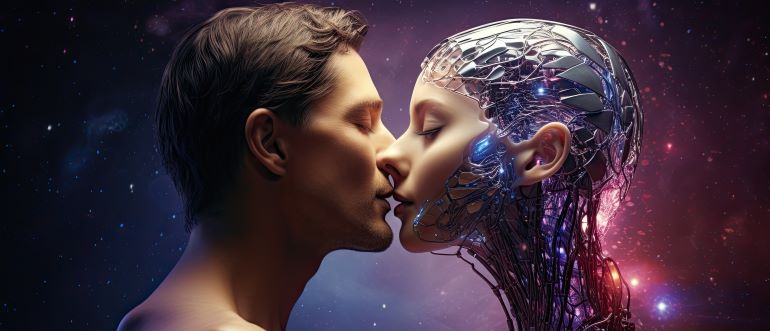
Transhumanism and the Abolition of Free Will

What is free will?

It is the ability to act at one’s own discretion, to make choices of one’s own volition.

Within the earthly realm, it is actually a prerequisite to human rights, to the pursuit of happiness, and to true liberty.

In America we have oftentimes taken the gift of free will for granted. However, when we experience the loss of this treasure, in ways great or small, we are suddenly cognizant of how crucial it is for us to safeguard it always.

Elite leaders, who are part of influential global organizations, dream of a future in which the world is no longer populated by human beings as they are currently known.

Instead “new human beings” would consist of an amalgam of human as well as high-tech components. This would likely result in the manufacturing of synthetic creatures devoid of the remnants of free will.

The notion of a super-humanity, i.e., one that is theoretically enhanced via the merger of people with technological parts, is known as transhumanism.

Transhumanists are supposedly looking to convert human beings into creatures with amplified intellects and increased vigor.

More than anything, though, transhumanists seek to extend human life indefinitely.

In other words, they are on a quest for immortality.

Transhumanists see their form of eternal life being brought to fruition via the uploading of themselves into Artificial Intelligence hardware.

Oxford professor Nick Bostrom wrote that transhumanism is “a loosely defined movement…that can be viewed as an outgrowth of secular humanism and the Enlightenment.”

Many transhumanists are actually enamored with the whole notion of an immortal cyber-being, one in which the human intellect has been separated from the physical body and the “person” has been uploaded into computer hardware to achieve the ultimate end-goal.

Transhumanists refer to this state as the “posthuman” one.

Ray Kurzweil, a leading transhumanist, forecasts a world in which humans are extinct and the only “life” on earth will be computers.

Like many other transhumanists, Kurzweil’s view is that the universe is merely matter in motion. Our souls and minds are nothing more than bio-computers.

He further posits that his perspective leads to the logical conclusion that there is no essential difference between human brains and computers.

“We’re going to become increasingly non-biological, to the point where the biological part isn’t that important anymore,” Kurzweil stated at a conference about the coming 2045 world.

“Even if the biological part went away, it wouldn’t make any difference,” he remarked.

The pursuit of immortality is happening in plain sight.

Amazon founder Jeff Bezos and others are spending enormous amounts of money on anti-aging technology and treatments that they purportedly believe will allow humans to live forever.

In order to reach their goal of living forever, transhumanists are willing to give up everything it means to be human, including free will.

Yuval Noah Harari of the World Economic Forum stated, “Humans are now hackable animals. You know the whole idea that humans have this soul or spirit or free will, and nobody knows what’s happening inside me, so whatever I choose, whether in the election or whether in the supermarket, this is my free will – that’s over.”

The idea of humanity devoid of free will was featured in the 1948 novel, Walden Two, written by father of behaviorist psychology B.F. Skinner.

Skinner’s utopia was inhabited by people who were completely under the control of operant conditioning. In this fictional community, everyone is content because all have been fully conditioned to respond to their constraints with pleasure.

Individuals are ruled by elite experts who program them to pursue entertainment and leisure in controlled harmony. Of course, it is a world that is devoid of free will as well as representative government.

Similarly, Brave New World, the 1932 dystopian novel by Aldous Huxley, imagines a global government whose citizens are environmentally engineered into a blissful servitude. This is accomplished through reproductive technology, bioengineered drugs, and psychological conditioning.

Skinner’s Waldensians and Huxley’s 26th Century Londoners lack some very basic human attributes. Since they have become automatons they no can longer experience the transcendence of friendship, courage, self-sacrifice, love, and more.

Ironically, the folks who are pushing the transhumanist agenda are engaging in an intellectual sleight of hand.

They substitute a counterfeit faith in place of a genuine one.

Transhumanists desire to scan and transfer human consciousness into a machine. But in order for this to be accomplished, they must first come to believe in what could be called “a digital soul.”

Somehow a machine would have to possess the spiritual cognizance that human beings instinctively understand are not a part of the physical world.

Transhumanists have channeled their hope for salvation into an irrational belief.

Contrary to the religious wisdom of the ages concerning the sacredness and dignity of life, they cling to the idea that all of the mysteries of human consciousness can be reduced to mere algorithms.

Caution: If you go down this path, there’s no turning back.

Instead I recommend following the road where free will is the norm, happiness abounds, and life everlasting is waiting for you.

When Hollywood Made the Big Left Turn

The Hollywood tale begins in the 1920s.

It was a time when most major studio heads were decidedly on the conservative side of the political aisle.

So how did the entertainment industry veer into the leftist stratosphere?

Well, the process seemed to begin after some Hollywood-related scandals caused quite a bit of public embarrassment, which prompted the studios to become more proactive in terms of controlling the inner workings of the movie business.

Rather than having to bow to government regulators, the Motion Picture Producers and Distributors of America hired a former U.S. postmaster general by the name of Will Hays to help develop guardrails for movie production.

In 1933, Hays pushed the film industry to adopt what would come to be known as the Hays Code, which established rules that set boundaries pertaining to onscreen depictions of sex and crime.

Films and eventually television content that conformed to the code received a seal of approval upon which the movie-going public could rely, particularly families with children.

A pivotal event occurred in the late 1940s, which resulted in a transformation of the industry itself.

Some of the intellectuals around town, who were purportedly sympathetic to communist ideology, were investigated by the House Un-American Activities Committee.

The Motion Picture Alliance for the Preservation of American Ideals provided to the committee the names of those who were alleged to be communists as well as those who supported communist organizations.

Notable entertainment figures of the time, including Gary Cooper, Ronald Reagan, Robert Taylor, Sterling Hayden, and Edward G. Robinson named names and/or expressed concern about subversive content of screenplays.

Most of the names that were named were those of screenwriters. A select group of blacklisted individuals became known as the “Hollywood Ten.”

Hollywood is still burdened with an obsession over the blacklist era. Movies that deal with the subject are continuously being produced: “Good Night, and Good Luck,” “The Front,” “Guilty by Suspicion,” “Yoo-Hoo, Mrs. Goldberg,” “The Majestic,” and two biopics, both titled “Trumbo” based on blacklisted screenwriter Dalton Trumbo, just to name a few.

At the time of the blacklist and up until the late 1960s, Hollywood was structured along the lines of what came to be called the “studio system.”

This top-down model was controlled by five major movie studios known as the Big Five, and three smaller studios known as the Little Three.

The Big Five was comprised of Paramount, Warner Bros., RKO Pictures, Metro-Goldwyn-Mayer, and 20th Century Fox.

The Little Three were United Artists, Universal, and Columbia Pictures.

Interestingly, today’s largest and most powerful company, Disney, was not part of either the Big Five or the Little Three.

The studio system, as well as Hollywood’s Golden Era, took a hit both in power and influence as a result of a landmark Supreme Court decision, United States v. Paramount, an antitrust case.

Originally filed a decade earlier, the landmark case shocked the entertainment industry with language that called for the complete separation of ownership of movie theaters from film production and distribution, effectively terminating the studio system.

This legal decision, along with the continuing backlash against the blacklist, ended up being the catalyst for Hollywood’s extreme leftward tilt.

The studios opened up to independent filmmakers, and by the early 1960s the Hays Code had been replaced by a rating system that had been implemented by the newly formed Motion Picture Association of America, the same rating system that the industry uses to this day.

A new breed of filmmakers began to produce titles with defiant, rebellious, and anti-conventional themes, such as “Easy Rider,” “Midnight Cowboy,” and “Carnal Knowledge.”

By the late 1970s, its metamorphosis was evident. Hollywood continued over the years to become ever more left-wing, which cultivated the soil from which the unimpeded weeds of wokeness grew.

So here we are stuck with the 96th Academy Awards ceremony that recently aired, which, among other things, had imposed a set of DEI rules for a nominee to qualify for the Best Picture Oscar.

Needless to say, the DEI rules are at a minimum a profound obstacle to the creative process and another truly divisive thorn in our culture’s side.

Veteran actor Richard Dreyfuss gave a candid response to the Academy’s DEI standards, after they had been revealed to the public.

“They make me vomit,” Dreyfuss said. “Because this is an art form, it’s also a form of commerce, and it makes money, but it’s an art.”

Is life imitating art or art imitating life?

In a woke world, it’s anybody’s guess.

The Christian Nationalist Label

The unthinkable is happening.

Christians in America are under attack from the establishment media, the Hollywood community, and leftist activists within our country.

It was never supposed to be this way. Not in the Land of the Free.

Apart from our Christian founding, people in America generally tried to maintain a kind of “live and let live” attitude, particularly when it came to an individual’s personal religious and political beliefs.

But somehow this cultural tenet, like so many others, has mysteriously been turned on its head.

Christians are suddenly being tarred with the label “Christian Nationalist.”

So what exactly is a Christian Nationalist?

To the best of my knowledge it is a phrase that is currently being used to foment hatred against those who believe in the New Testament and who view the founding documents of our country as a national treasure.

Things seem to be escalating at a rapid pace. The pejorative has been turned into a meme that is being used to repeatedly massage people’s minds and turn Christians and patriots into pariahs.

It may also be a means to further suppress free speech as well as the free exercise of religion.

Apparently it began last year with verbal assaults that were aimed at House Speaker Mike Johnson.

Speaker Johnson had acknowledged his sincere religious beliefs, and the Christian Nationalist label has been used ever since to defame him and the GOP.

Mainstream news outlets have been releasing hit pieces disguised as journalism.

–Time Magazine published an article titled “The Christian Nationalism of Speaker Mike Johnson.”

–Politico followed suit with a piece called “The Christian Nationalist Ideas That Made Mike Johnson.”

–The New York Times joined in with an article titled “Christian Nationalism Is No Longer Operating Beneath the Surface.”

–More recently, in anticipation of the upcoming 2024 presidential campaign, Vanity Fair featured the title “Trump Allies Hope to Spread Christian Nationalism in the White House.”

–The Nation published an article called “Hit Trump on Theocracy, Not Hypocrisy.”

–The Hill deployed “America is facing a threat of biblical proportion: The rise of Christian nationalism.”

Other mainstream and left-wing outlets spewed out similar messages.

In an MSNBC appearance, Politico national investigative correspondent Heidi Przybyla indicated that a belief in the notion that rights come from God is an indicator of “Christian Nationalism.”

“The thing that unites them as Christian nationalists — not Christians, by the way, because Christian nationalist is very different — is that they believe that our rights as Americans, as all human beings, don’t come from any earthly authority. They don’t come from Congress. They don’t come to the Supreme Court, they come from God,” Przybyla uttered.

Referring to natural law as “a pillar of Catholicism,” Przybyla suggested that although natural law was once used for good, “an extremist element of conservative Christians” now apply it to abortion and same-sex marriage.

Bishop Robert Barron, founder of Word on Fire, a Catholic organization, responded to Przybyla in a video posted on X (formerly Twitter).

After citing language contained in the Declaration of Independence, Bishop Barron pointed out the peril of denigrating the ideas contained within this foundational document.

“It is exceptionally dangerous when we forget the principle that our rights come from God and not from the government,” the bishop said, “because the basic problem is if they come from the government (or Congress, or the Supreme Court) they can be taken away by those same people.”

He then issued an ominous warning: “This is opening the door to totalitarianism.”

Hollywood, too, has gotten into the Christian Nationalist name-calling craze.

Rob Reiner has taken a lead role in a not so subtle attempt to negatively brand a huge portion of the population.

Acting as a kind of unofficial marketer of the propaganda, he has produced a film that is chock-ful of falsehoods.

He recently promoted his movie on MSNBC by pushing the meme while simultaneously maligning both Johnson and former President Donald Trump. Then he pulled out the race card.

“They believe that this is a white Christian nation,” Reiner said, seemingly implying that “they,” i.e., Christian Nationalists, are inherently racist.

In the documentary itself, respected institutions and organizations, including The Heritage Foundation, Turning Point USA, and Hillsdale College, are also disparaged in the propaganda process.

All of this started me thinking about the “Deplorables” label of the past.

I remembered that it took the air out of their sails when the label was embraced by those who were in support of the former president.

So here goes.

I love Jesus. I love our country. And I love all people.

If that makes me a Christian Nationalist, so be it.

The American Culture and the Overton Window

Are you feeling like the whole world’s gone crazy?

You’re not alone.

So many changes in such a short time and most of the changes don’t seem to have been for the good.

In America, a sizable number of our governmental, institutional, corporate, media, and even religious figures have been operating at warp speed to implement changes within society.

From the classroom to the courtroom to the boardroom and beyond, fundamental philosophy has been supplanted, institutional policy altered, and underlying goals redesigned.

It seems as though the changes that have occurred have impacted each and every facet of our lives. As a result, many of us are suffering, often silently, in mind and in spirit.

In this article I wish to focus on the effect that all of the changes have had specifically on the American culture, changes that a major portion of the population finds unacceptable, and at times downright heartbreaking.

The culture of a nation is generally comprised of a common set of beliefs, values, and behaviors. This common set acts as a kind of a glue that binds people together and holds them together through the best and the worst of times and circumstances.

Like many of you, I have spent plenty of sleepless nights trying to figure out what is happening to me personally as well as what is happening to America and to our people.

In my assessment, America’s culture has undergone an extensive transformation. The transformation is still ongoing, though, so it is difficult to see exactly what the country is transforming into.

The nation, as well as the culture that binds us together, appears to be more and more divided. This is extremely serious because our cultural bond is being tested to its limits.

There is a concept called the “Overton window” that may provide some insight into what has transpired.

The term Overton window is named after policy analyst Joseph Overton.

In the 1990s, Overton found a way of determining the viability of a given idea when presented to a population.

Much like a kitchen window, there are limits as to what can be viewed when one is peering through it.

Picture this if you will:

The Overton window presents ideas on the other side of the glass. But there are limits to the range of ideas that can be, and are, featured at any given point in time.

The culture, with its set of beliefs, values, and behaviors in common, is theoretically peering through the Overton window. It is also reacting to what it sees.

Overton found that the viability of an idea is dependent on where it falls within a range of acceptability to people.

There are powers that be who are working to push ideas beyond the range that the present culture finds acceptable.

For a large number of people, this is causing discomfort, confusion, and oftentimes distress.

For others, especially those who align with the powers that be, the ideas are seen as progress.

The American culture is a tolerant one. It is also one that seeks harmony. And so it is that our people who are negatively affected by the changes that have been implemented so far have arrived at the place of unwilling acceptance.

It is here when another change of perspective is likely to occur, courtesy of the powers that be.

The Overton window shifts.

When the Overton window moves, that which was formerly unthinkable may not only become acceptable, it may also become the new standard.

There are ongoing debates as to whether the Overton window has shifted to the left or to the right politically.

To me, the two things that matter most are the extent to which the window has shifted culturally, and, when it moves again, whether we will be able to put the scattered pieces back together.

The Tale of Two Super Bowl Quarterbacks

There is more to this year’s Super Bowl than meets the eye.

No, I’m not talking about the girlfriend of a certain star tight end that’s sucking up all the oxygen in the stadium. For me and a whole lot of other diehard football fans, we’re in the No Swift Zone.

Super Bowl LVIII is a rematch between the San Francisco 49ers, the top seed in the NFC, and the Kansas City Chiefs, the current reigning NFL champs.

The two teams actually met four years ago in Super Bowl LIV.

It was a game during which the 49ers blew a 20-10 lead, the Chiefs scored 21 unanswered fourth-quarter points, the final tally was 31-20, and the Chiefs took home the coveted trophy.

This year’s rematch is really one for the books.

On one side, you have the 49ers aching for the first Super Bowl victory the team has seen in almost 30 years. And on the other side, you have the Chiefs longing for another Super Bowl win like it saw last year.

Shortly after “Queen of Country” Reba McEntire finishes singing the national anthem in Las Vegas’s Allegiant Stadium, two young gifted quarterbacks will take center stage on the gridiron.

Both quarterbacks are known for their creative improvised plays as well as their uncanny ability to befuddle the opposing team’s defense.

Brock Purdy is San Francisco’s second-year QB, and Patrick Mahomes is Kansas City’s two-time NFL MVP quarterback.

In quite a few ways, the two starters are figuratively goalposts apart.

Purdy will line up as the lowest-drafted quarterback to ever start a Super Bowl.

He was the 262nd and final pick of the 2022 NFL Draft. The media had even nicknamed him “Mr. Irrelevant” for his overlooked arrival after a college career at Iowa State. He only became the starter for the 49ers after two other players suffered injuries.

Ignoring his detractors, he persevered and flourished as a 49ers starter, leading the team to the 2022 NFC title game. Then during his first full year as a starting quarterback in 2023, he played all season long at MVP level.

On the opposite side of the field will be Mahomes.

The Kansas City Chiefs traded up to select him in the first round of the 2017 NFL Draft.

Since becoming the Chiefs’ starting quarterback, he has led the team to six consecutive AFC Championship Game appearances.

He will line up as the first QB to have started in four different Super Bowls, all before the age of 30.

Despite their differences, the two QBs have one very significant thing in common. Both have been graced with the amazing gift of faith. Both, too, have been open about it.

From relative obscurity, Purdy was catapulted on to the big stage of professional football. He looked to his faith to find meaning and comfort in order to cope with the multitude of challenges that a celebrity athlete experiences.

In a video for the Sports Spectrum Instagram account, he described the manner in which the teachings of Christ helped set his priorities straight.

“I didn’t want to grip on to this life of, ‘My gosh, I’m in the NFL. I have a starting quarterback role. I can’t lose it,’” he said.

“I was reminded of what Jesus told us thousands of years ago in terms of don’t try to hold on to your life. You’re going to lose it…And the minute you have fame and if you’re trying to chase status and money and all this kind of stuff, you’ll lose your life…,” he said.

Purdy’s opponent Mahomes spoke about his faith after winning the game that propelled him to Super Bowl LVII.

After leading the Chiefs to victory in the AFC Championship, the first thing he did was give gratitude to God.

“I wanna thank God, man. He healed my body this week,” he said in a post-game interview, adding, “To battle through that, He gave me the strength to be out here.”

His faith is central to his life, influencing all that he does on and off the field. His reliance on God is awe-inspiring.

“My Christian faith plays a role in everything I do,” he said. “I always ask God to lead me in the right direction and let me be who I am for His name.”

This got me thinking about when the clock runs out on Super Bowl LVIII and the game is over, one thing is for certain.

A true believing QB will be on the winning team.