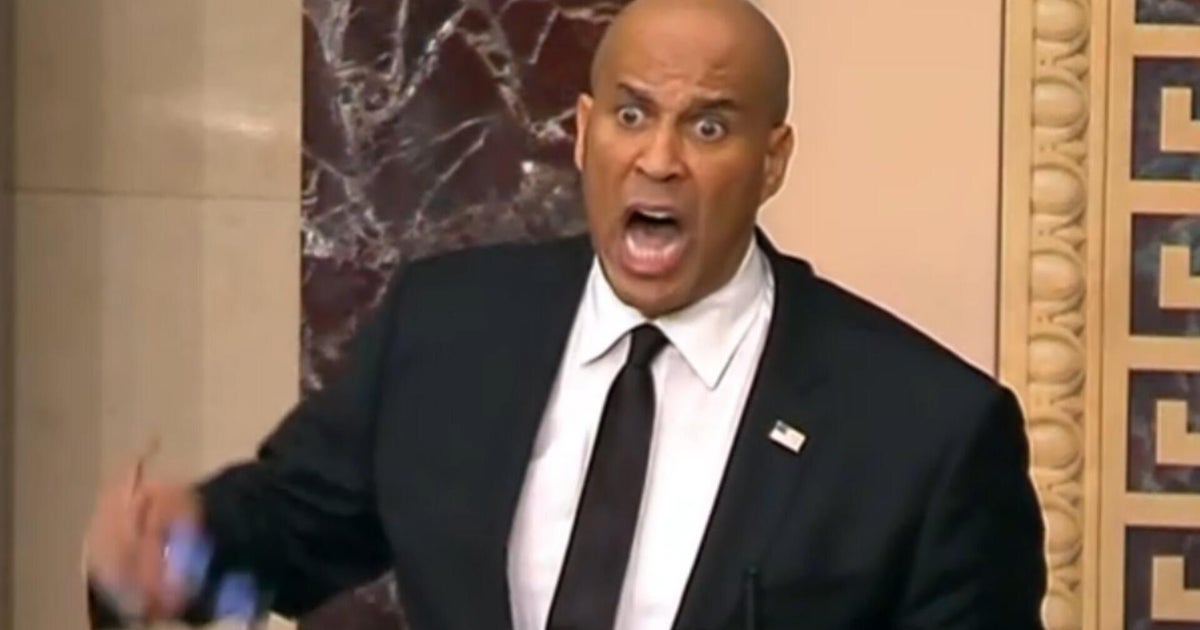
Democrats have been making the rounds on podcasts, cussing up a storm, singing sixties songs, and putting on their best tough guy and gal faces.
It’s all a desperate attempt to win back the voters they lost along the way to the Land of Woke.
Negative public feedback as well as pathetic polling results indicate their antics aren’t working. But they keep on trying.
Apparently, no one has told them yet that it is impossible to resonate with people if you haven’t got a message that’s worth hearing.
Envious of President Donald Trump’s positive poll numbers as well as his widespread appeal, Democrats have adopted a cheap imitation strategy in hopes of once again duping folks.
Recent stunts by Dems include former veep Kamala Harris’s unofficial beer summit with late-night host Stephen Colbert, Left Coast congressman Eric Swalwell’s anti-GOP jaw-flapping gym session, and Garden State Cory Booker’s “Jersey Shores”-style rant on the Senate floor.
Their machinations have consistently come across as unimaginative, juvenile, and inauthentic.
Why would prominent Democrat figures engage in such undignified behavior? The numbers provide the likely explanation.
According to The New York Times, when it comes to voter registration, Democrats are “bleeding support beyond the ballot box.” All of the 30 states that track voter registration by political party measured severe drops in Democratic Party registrations in between the elections of 2020 and 2024.
A recent survey from CNBC indicates that the Dem’s net favorability has hit a near three-decade low.
The Democratic Party carries a -32 net favorability rating among registered voters, which is the lowest rating for either the Democratic or Republican Party going as far back as1996.
The Dems have a 24 % positive rating and a 56 % negative rating.
A recent YouGov poll shows that 58% of Democratic voters view their leaders as “out of touch,” compared to only 42% of Republicans who view their leaders in the same way.
A recent Gallup poll indicates that 54% of Americans trust Republicans more on economic issues, compared to 39% for Democrats.
The numbers suggest that people are seeing through the political theatrics. The Democrats lost 2.1 million registered voters across 30 states and Washington, D.C., while Republicans gained 2.4 million registered voters.
These numbers reflect the self-evident principle that authenticity is something that cannot be concocted.
Democrats, many of whom have presidential ambitions, are attempting to duplicate President Trump’s communication and leadership style. Interestingly, pretending to be him just isn’t cutting it.
That’s because President Trump isn’t method acting. He’s himself 24/7. His comments resonate because they are routinely unscripted, unvarnished, and unapologetic. The exact opposite of the Dem Trump wannabes.
While the Democrats have been hard at work creating TikTok videos, President Trump has been hard at work solving problems. He makes sure that he updates the public each day, reporting on issues that have been resolved and those still in need of tackling. And he spells all of it out in primary colors so we don’t have to carry a pocket dictionary or woke wordbook to figure out what he’s trying to tell us.
Democrats are seemingly stuck in an unending sequel to High School Musical. They may be having fun but they don’t realize they aren’t being laughed with, they’re being laughed at, in addition to subsequently being ignored.
The backlash on social media confirms that their calculated spectacles are backfiring, perceived by the public as second-rate and utterly fake.
Reportedly, Democratic strategists have privately warned that the approach risks turning candidates into caricatures. Recent polling data indicate that voters want political candidates to be real. A Rasmussen survey from early 2025 shows 63% of the all-important independents say they’re less likely to vote for candidates who “try to act like someone they’re not.”
The younger voter demographic that Democrats covet appear to be increasingly apathetic. Only 49% of Gen Z voters plan to turn out in 2026, according to a recent Tufts University study. This number is down from the 57% seen in 2020.
The reason for the drop is simple. Many of the young people cited distrust of politicians, who in their words are “pretending to be like us,” as the reason for their pulling away.
Authenticity is a difficult concept to describe, but humans seem to have an inner sense of whether or not a fellow human being is being genuine.
In terms of the way in which Dems have been behaving, folks additionally sense what authenticity is not about.
It’s not about mugging for the cameras, showing off one’s talents or lack thereof, chasing internet fame, or channeling another person’s persona.
With regard to public service, authenticity is about being honest about who you are, straightforward about what you stand for, and resolute in putting the needs of your constituents ahead of your own. Things that the current iteration of the Democrat Party either can’t or won’t do.
If the Democrat Party doesn’t learn the authenticity lesson in a hurry, the curtain just may come down before the play is over.
 James Hirsen
You must be logged in to post a comment.