Democrats and Media Allies Stoke Coronavirus Fears

mainstream-media

As the saying goes, “If it bleeds it leads.”

It has been this way across history for the dominant media of the day.

In their endless quest for the most compelling stories, natural disasters, widespread tragedy, political intrigue, criminal conduct, and the like have routinely provided the news and entertainment story fodder.

However, today’s times are unlike any that our country has previously experienced. This is mainly due to the fact that the dominant news and entertainment media have undergone a dramatic change in form and substance. The info-tainment industries have actually devolved in a way never anticipated, and unfortunately they have become an apparatus of one political party in particular, the Democratic Party.

In relation to the current reigning story, COVID-19, commonly referred to as the coronavirus, the Democrats and their news and entertainment cohorts have been working overtime to ratchet up the levels of public anxiety and alarm.

No doubt both the Democrats’ rhetoric and the media coverage of the coronavirus outbreak have grown increasingly duplicitous. Unfortunately, this is diametrically opposed to what is needed for our society to keep things in proper perspective, remain productive, and maintain a healthy outlook.

It is an axiom that when something poses a risk to the population, dissemination of accurate and objective information is key to reaching a solution. Presently, however, a kind of hysteria surrounding the coronavirus has been generated by partisan news media that have the ultimate goal of bringing down the approval ratings of President Donald Trump.

Democrats across the left-leaning spectrum and their willing media accomplices have politicized the current health-related issue to a sufficient degree that susceptible individuals have been driven into a state of uncertainty about their personal health and that of their families.

Such confusion about one’s personal circumstances may oftentimes lead to feelings of fear and apprehension that are not easily remedied even when the truth emerges.

With full knowledge that the public would likely overreact to exaggerated reporting, much of the news media have amplified the scare factor of the coronavirus story, creating a distorted perception in the minds of the public. The 24-hour cable news cycle and the social media have been working in conjunction to reinforce the misleading message.

Fear mongering by the left-leaning media is nothing new. The difference this time around, though, is that the media have abandoned all pretense of conveying factual information. They seem to have adopted a single rule with which to measure a publication’s worthiness: Will the “story” hurt President Trump? If the answer is yes, run with it.

Anything that can be blamed on the president will be.

Case in point: The U.S. newspaper of record, the New York Times, published a headline in its op-ed section that read, “Let’s call it Trump virus. If you’re feeling awful, you know who to blame.”

At a recent rally, President Trump brought up the way in which the coronavirus has been publicly discussed, highlighting a particular focus on an attempt by Democrats to massage the public psyche.

“Now, the Democrats are politicizing the coronavirus…” Trump told the crowd.

The president then spoke about an individual who had suggested that the Democrats were perpetrating a hoax similar to the now-discredited Russia collusion narrative.

“One of my people came up to me and said, ‘Mr. President, they tried to beat you on Russia, Russia, Russia…they tried the impeachment hoax… they tried it over and over and they’ve been doing it since you got in…this is their new hoax.’”

When looked at in context, one should logically conclude that President Trump was referring to the Democrat and media attempts to accuse the administration of mishandling the response to the coronavirus. Rarely relying on logic, the left instead proceeded to mischaracterize his comment, taking aim directly at the word “hoax.”

Washington Post columnist Dana Milbank tweeted, “Remember this moment: Trump in South Carolina just called the coronavirus a hoax.”

Ken Dilanian, a correspondent for NBC News, used his Twitter account to perpetuate the falsehood by posting, “Trump calls coronavirus Democrats’ ‘new hoax.’”

Other news outlets used distorted and misleading headlines to convey the notion that the president, shortly after creating a task force to deal with the coronavirus, called the virus itself a “hoax.”

Democrat House member Ted Lieu tweeted, “Dear @realDonaldTrump: I hope you apologize for using the term ‘new hoax’ in connection with the #coronavirus outbreak.”

Democrat presidential candidates Joe Biden, Mike Bloomberg, and recent exiter Pete Buttigieg jumped in to repeat the lie.

The truth is no action that the president would have taken to respond to the coronavirus would have satisfied Democrats or the media.

Interestingly, ignored by the same partisan figures are the hundreds of thousands of lives lost each year due to tuberculosis and AIDS, as well as the tens of thousands who die because of the flu.

Another truth nugget is that our country has an amazing track record of dealing with the risk of contagious diseases. Ebola, Severe Acute Respiratory Syndrome (SARS) and Middle East Respiratory Syndrome (MERS) were all handled with skill and expertise and were significantly contained.

When the facts are fully known, expect the U.S. response to the coronavirus to be successful.

Watch also for the doomsday predictions given by Democrat politicians and left-leaning media to end up on top of a trash heap of failed hoaxes.
Justice Sotomayor Criticizes Colleagues

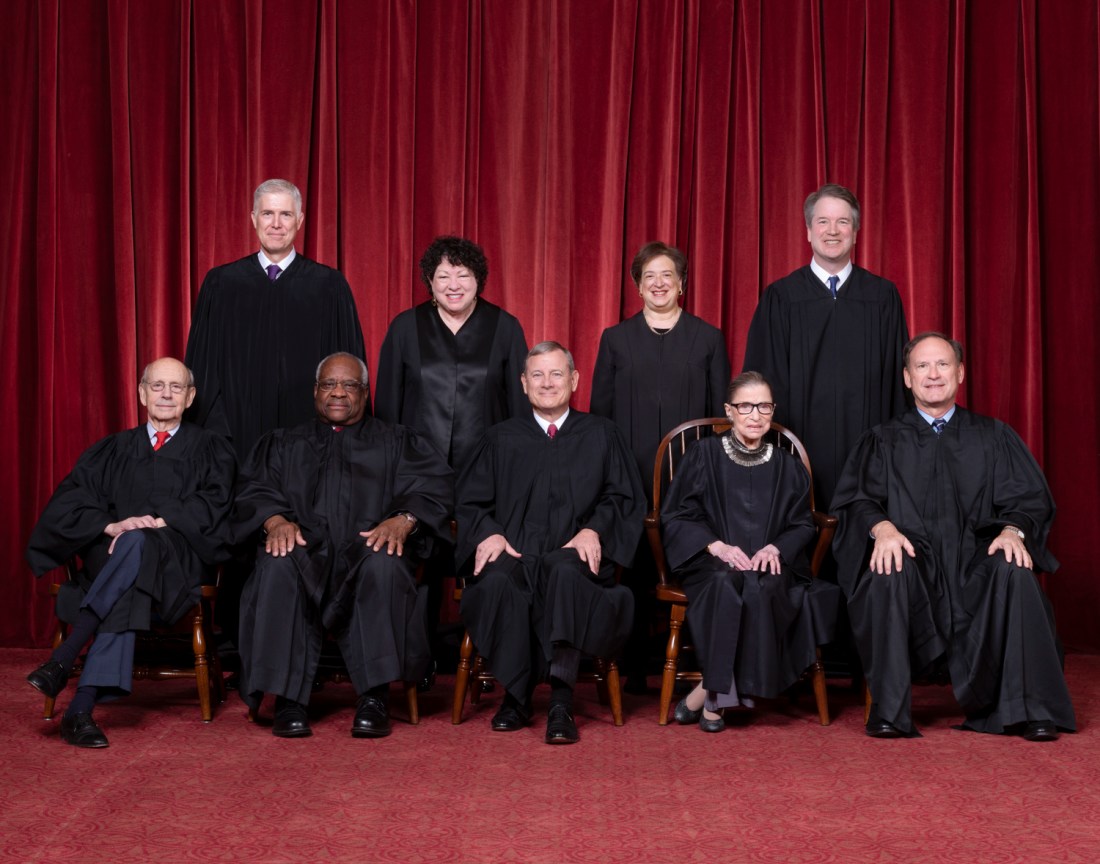
2018 Roberts Court

In a recent dissent to a Supreme Court decision, Associate Justice Sonia Sotomayor crossed the bounds of judicial norms by accusing her fellow Supreme Court colleagues of being biased toward the Trump administration in carrying out their judicial work.

The case before the High Court, Wolf v. Cook County, deals with circumstances in which the government could deny visas or green cards to non-citizens who are looking to enter the United States.

In 2019 the Trump administration, via the Department of Homeland Security, issued a new rule to be used for the purposes of determining whether an individual could be granted legal entry into the United States.

The executive branch already had the authority to determine whether an individual who applies to enter the country is likely to become a “public charge,” i.e., a person “primarily dependent on the government for subsistence.”

However, certain non-cash financial aid items, such as food stamps, housing, and health care assistance, were not previously taken into account for such purposes, but were included under the new Trump administration rule.

Prior to hearing this case, the High Court had blocked two nationwide injunctions that were issued by lower courts, resulting in the enforcement of the new rule. However, a third injunction, which was limited only to Illinois, remained in effect, barring the implementation of the new rule in that state.

The Trump administration filed an application with the High Court for an emergency stay, which requested that the Justices block the Illinois injunction that allowed Illinois to continue to exclude non-cash financial aid items from being a part of the dependency assessment.

The High Court’s decision to halt the Illinois injunction and allow the state to consider non-cash financial aid thus enabled federal authorities to enforce the new policy in Illinois.

In her dissent, Justice Sotomayor enlisted a highly unusual comparison to bolster her argument against the majority’s approach to the government’s stay applications. Drawing similarities to arguments brought by those advocating for death row inmates, Justice Sotomayor accused fellow members of the High Court of showing greater concern for President Donald Trump than for convicts facing execution.

In an apparent incrimination of five of her fellow colleagues, Justice Sotomayor alleged that they had politicized their rulings.

Justice Sotomayor had voted in the subject case, Wolf v. Cook County, along with three Democrat-appointed Justices, Ruth Bader Ginsburg, Stephen Breyer, and Elena Kagan.

As a Member of the Bar of the Supreme Court, I have had the privilege of having dozens of cases come before the High Court and found it disconcerting to read that Justice Sotomayor had written that the five Republican-appointed Justices were “putting a thumb on the scale in favor” of the Trump administration.

There is an unspoken yet palpable expectation that political opinion as it may potentially relate to a judicial ruling would be conspicuously left behind at the courthouse steps.

In addition, Justice Sotomayor was highly critical of the frequency of the relief from the High Court, in the form of stays against injunctions, which had been sought by the Trump administration.

“Claiming one emergency after another, the Government has recently sought stays in an unprecedented number of cases, demanding immediate attention and consuming limited Court resources in each,” Justice Sotomayor wrote. She went on to assert that the High Court is biased in favor of the Trump administration when it comes to these stay applications.

The notion asserted by Justice Sotomayor that the Republican-appointed justices on the High Court are politically biased does not appear to square with the records of Chief Justice John Roberts and Justices Brett Kavanaugh and Neil Gorsuch.

In 2012, Chief Justice Roberts, who was appointed by President George W. Bush, wrote the majority decision in favor of the Affordable Care Act, which was a clear departure from conservative ideology. And Justices Kavanaugh and Gorsuch, both of whom were appointed by President Trump, have sided at times with the four Democrat-appointed justices in relation to several cases.

In her recent writing, Justice Sotomayor appears not to have taken into account the reason for the larger number of stay applications. The increase is due to the unprecedented use of the federal courts by opponents of the president.

In 2019, during a speech to the American Law Institute, Attorney General William Barr cited the widespread use during President Trump’s term of nationwide injunctions that affect presidential policies.

The numbers correspond with the misuse of the judiciary in an unparalleled way. During the entire 20th century, courts issued just 27 nationwide injunctions of this type; however, in the three short years that President Trump has occupied the Oval Office, activist judges have attempted to hamper his administration with 40 nationwide injunctions.

“When a nationwide injunction constrains a significant executive policy, the Justice Department has little choice but to seek emergency relief,” Attorney General Barr noted. “… the alternative is for the government to wait months or years for appeals to run their course before the executive may implement its policy at all.”

No Equal Justice, No Freedom

cnn-fbi-roger-stone-raid-998x562-1

Those who administer criminal justice in our country have historically sought to be consistent with the fundamental American tenet that all are “created equal.”

In recent times, though, criminal laws have been applied by powerful institutions in a manner that is dramatically unbalanced, and the contrast has been jarring.

Former Trump campaign adviser Roger Stone was taken into custody in a mode that has traditionally been reserved for the most dangerous criminals. Twenty-nine heavily armed agents, 17 vehicles, a helicopter, and two amphibious units were deployed to carry out a pre-dawn raid on a 67 year-old man with no prior criminal record. By the way, CNN had been tipped off, and the tactical team showed up only after cameras were in place.

Stone was aggressively prosecuted for process crimes that had arisen during the investigation. Contrast this with the case of fired FBI Deputy Director Andrew McCabe, who lied under oath while in his official capacity. McCabe was neither arrested nor prosecuted. Instead he was allowed to cash in on his name recognition as a CNN contributor.

It has become crystal clear to anyone who has observed these cases, as well as other high-profile prosecutions or lack thereof, that the criminal justice system has not been equally applied.

Most Americans sense that fairness requires, even demands, a single justice system be firmly in place, as opposed to a multi-tiered one. Denying the constitutional mandate for the “equal protection of the laws” is dangerous to the freedom that our nation treasures.

The guardrail, which stands between our freedom and tyrannical rule, is much thinner than we think. If lack of equality in the administration of criminal law by a government is left unchecked, what will stop that government from engaging in more serious abuses of the legal process?

The use of the criminal justice system as a means of eliminating political opposition is a practice that has been consistently used by totalitarian regimes, and those governments that are on the road to totalitarianism.

The way fully developed unequal justice would manifest itself in a tyrannical regime is via a public trial in which the guilt of the accused is pre-determined by the judicial authorities before the process ever begins, a.k.a., a “show trial.”

By holding a counterfeit trial, an undemocratic government is able to eliminate foes and, at the same time, warn others as to the consequences of dissent or opposition. The misuse of criminal law and procedure is, in fact, the ultimate propaganda.

The world is full of examples of this malevolent misuse of judicial institutions. In Soviet Russia, criminal trials were meticulously staged. If the accused did not admit guilt for fabricated crimes, he or she was deemed to be “uncooperative” and would oftentimes be summarily executed without a public show trial.

In the early 1920s, fake criminal proceedings known as “model trials” were used by communist oppressors to make an example of individuals both in Russia and the Ukraine.

In the 1930s, the cold-blooded dictator Joseph Stalin used faux criminal justice to suppress any possible criticism, opposition, or dissent via the Moscow Trials of the Great Purge. The discredited New York Times reporter Walter Duranty claimed at the time that these due process-free trials were actually fair.

During the 1950s, after the communists took control of China, the Communist Party under Mao Zedong charged thousands of people with crimes and, after show trials, many ended with a death sentence.

In 1989 the memorable Tiananmen Square student-led protests took place. The demonstrations were indelibly stamped in the minds of Americans when video footage and photographs emerged of a lone man standing in front of a column of tanks. Show trials were given to many of the protestors who were arrested and charged as communist-termed “rioters and counter-revolutionaries.”

Between 1933 and 1945, the Nazi government established a large number of “special courts” that used made-up crimes to wage pre-determined prosecutions on individuals who were perceived as hostile to the regime. Thousands of German lives were taken on the orders of the “special courts.”

These examples compel us to pursue the ideals that are reflected in our founding documents and legal traditions.

A phrase that sums up the legal foundation of fairness is engraved on the front of the United States Supreme Court building in Washington, D.C. It reads “EQUAL JUSTICE UNDER LAW.”

These words re-phrase the Court’s unanimous decision applying the Fourteenth Amendment, when then-Chief Justice Melville Fuller wrote that “…no State can deprive particular persons or classes of persons of equal and impartial justice under the law.”

How Trump’s Impeachment Record Can Be Wiped Clean

5dc7487a25fce.image_

An idea has been floated by Republican leaders to pass a resolution that would fundamentally alter the impeachment record of President Donald Trump.

The means that would be used to bring about the auspicious outcome is a legislative approach commonly known as expungement. When finalized, the “impeached” label would be amended in the record books, as would the “forever” characterization attached to it by the House Speaker.

More than merely a sound idea, expungement is a necessary one because of the fatally flawed process that the House of Representatives used to pursue the impeachment of the president in the first place.

The impeachment inquiry began without a vote. The hearings featured secret witness “auditions.” The evidence produced was largely inadmissible hearsay and opinion. And rules that were imposed during the process prevented the accused from mounting a defense.

The above mentioned, as well as other defects in due process, make it imperative for the GOP to re-take the House of Representatives and for the new leaders to expunge the impeachment of the president, which will thereby restore integrity to the record.

House Minority Leader Kevin McCarthy is on record as being in support of this concept.

“This is the fastest, weakest, most political impeachment in history,” McCarthy told the New York Post. “I don’t think it should stay on the books.”

In addition to McCarthy, influential GOP members of the House, including Rep. Jim Jordan (R-Ohio), Rep. Louie Gohmert (R-Tex.), Rep. Mike Johnson (R-La.), Rep Lee Zeldin, (R-N.Y.), and Rep. Chip Roy (R-Tex.), have all voiced approval of the idea.

So has President Trump. When asked by a reporter whether he believed the House should expunge his impeachment from the congressional record, the president responded, “They should because it was a hoax. It was a total political hoax.”

Expungement of a presidential impeachment remains the subject of debate by legal scholars. In my personal legal opinion, though, it clearly can be done.

If we take a look back at the seventh U.S. president, Andrew Jackson, we see where the precedent for an expungement was set

In 1832 President Jackson, a Democrat, ran for re-election. His opponent was National Republican Party candidate Henry Clay. Jackson won.

However, Clay’s party took control of the Senate. Under Clay’s leadership, the Senate demanded the delivery of documents from the Jackson cabinet related to a dispute over a presidential veto. After President Jackson refused to release the documents, Clay introduced a resolution to censure him, and after weeks of debate the resolution was passed.

Then in 1837 the Democrats regained the majority in the Senate. They proceeded to have President Jackson’s censure expunged from the record.

If a federal legislative body has the power to expunge a resolution that censures the president, I contend that it likewise has the ability to expunge an impeachment.

Some cable news experts have argued that if the House could expunge an impeachment, it would have done so with President Bill Clinton. Interestingly, this is precisely what Democrats tried to do.

The year was 2010. A dozen years had passed since the impeachment of President Clinton had taken place for misconduct relating to an affair with a White House intern named Monica Lewinsky.

Rep. Chaka Fattah (D-Pa.) introduced legislation to expunge the Clinton impeachment. He was unsuccessful in his effort, and later he himself wound up in prison for bribery, money laundering, and fraud.

A Republican House can and should work to expunge from the record the impeachment of President Trump. A GOP-controlled House would not be bound by an impeachment resolution passed by a previous House.

Although it is unlikely that some of the more vocal opponents would be silenced, an investigation by a GOP-controlled House may have an effect on the way in which history would be interpreted.

House Republicans plan to investigate lead impeachment manager Rep. Adam Schiff (D-Calif.) and/or his staff’s potential connections to the so-called whistleblower. There is an origin story to the manner in which the whistleblower’s information came to light and the reason why it conflicted with the actual transcript of the president’s telephone call.

The withholding of the 179-page transcript of testimony given by the eighteenth witness, a.k.a., the inspector general of the intelligence community, will be one of the first documents a future Republican House will want to see.

Supporters of President Trump and many independent voters observed how the House hearings were conducted and largely concluded that the impeachment process was unfair to the president.

Increasing public awareness of the potentiality for an expungement will have a ripple effect in the political world and may ultimately boost an already high GOP enthusiasm level, which will assist Republicans in flipping the 18 seats needed to regain control of the House.

Expungement just may be right around the 2020 corner.

Democrats Try to Undermine a Trump Acquittal

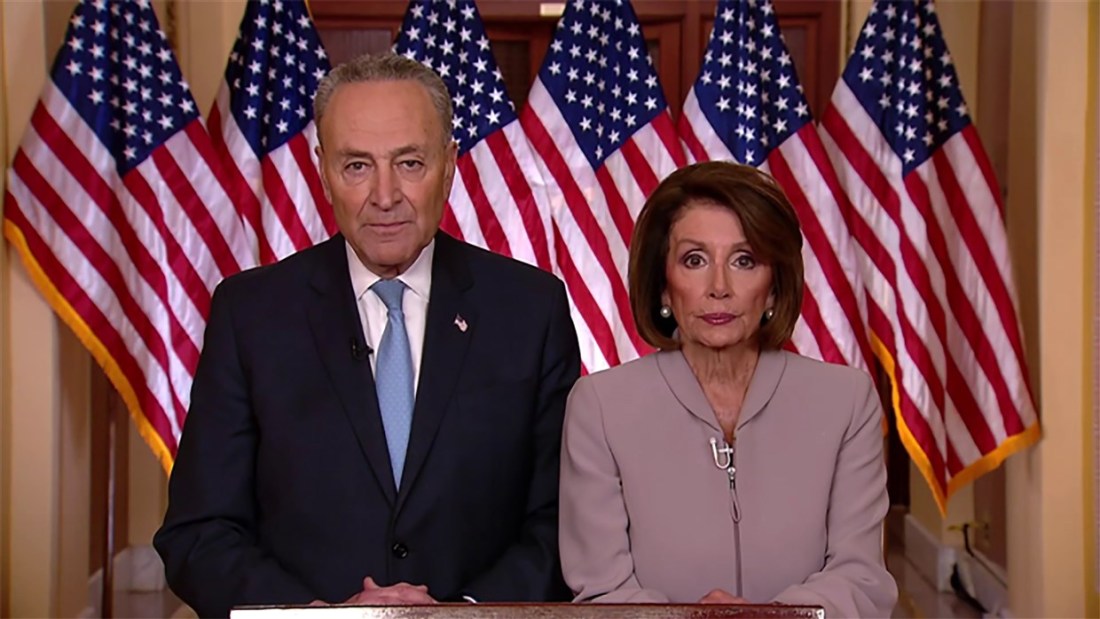
190108-chuck-shumer-nancy-pelosi-snip-ac-918p_aa101e7d92c9e80dcc5bb8e9d9f46cab.fit-1240w

As the impeachment trial of President Donald Trump comes to a close, Democrat resistors are having a hard time coming to grips with an impending acquittal.

Perturbed members of the opposition party have now chosen to engage in a smear campaign that characterizes the Senate proceedings as illegitimate.

Using a worn-out playbook from past attacks, some of the more spiteful Dems are trying to massage the minds of a would-be unsuspecting public that the acquittal of President Trump somehow lacks legitimacy because of a supposed deficiency of witnesses or documents.

In an appearance on Bill Maher’s HBO show on January 17, 2020, House Speaker Nancy Pelosi said the following: “You are impeached forever,” punctuating her comment with the line, “No matter what the Senate does, it [impeachment] can never be erased.”

On January 30, 2020, the day before the Senate voted against subpoenaing additional witnesses or documents, Pelosi said to a reporter, “You cannot be acquitted if you don’t have a trial. You don’t have a trial if you don’t have witnesses and documentation and all of that.”

The very next morning, which was also prior to the pivotal Senate vote, Senate Minority Leader Chuck Schumer said, “The president’s acquittal will be meaningless, because it will be the result of a sham trial. If there are no witnesses, no documents in this trial, there will be a permanent asterisk next to the acquittal of President Trump written in permanent ink.”

Other Democrats joined in with the spin, as did most of their willing media accomplices.

Many will recall when the Democrats flooded the media with a similar set of talking points at the conclusion of the confirmation process for then-Supreme Court nominee Brett Kavanaugh. Some of the more spiteful Dems contended that the process would be unfair and tainted if there was not a delay for an FBI investigation.

After the president and the GOP relented to a week-long FBI investigation, certain Democrat office-holders ran to the microphones to assert that the investigation was insufficient and the confirmation process flawed.

Once again, it really would not have mattered how the GOP senators had proceeded with the impeachment trial. If the trial did not match the outcome that the removal-oriented Democrats wanted, they would have followed up with a coordinated negative message anyway.

The Constitution grants the Senate the sole power to try all impeachments. The Speaker of the House has no real role in an impeachment trial. However, as Pelosi did when she conditioned the delivery of the Articles of Impeachment, the House speaker is attempting to exercise influence and exert control over the Senate impeachment function.

In stark contrast to the way in which the House hearings unfolded, the Senate conducted the impeachment trial process in a fair and dignified manner. While carrying out its constitutional duty, the Senate received and considered a record produced by the House of Representatives. Seventeen of the 18 witnesses from whom the House obtained testimony had their transcripts released. Noticeably absent was the transcript of Intelligence Community Inspector General Michael Atkinson, who gave testimony that is widely believed would have been helpful to the president’s case.

During the Senate trial, members of the Senate, acting as a jury, listened to more than 190 portions of testimony from 13 of the House witnesses, and additionally had access to almost 29,000 documents.

It was the House Democrats who made the decision to disallow any witnesses that would support the president’s case. It was also the House Democrats who chose not to subpoena other witnesses, because they apparently did not wish to take the time to allow the judicial branch to do its job; that is, the job of dealing with the important constitutional issue of executive privilege.

Some of the more spiteful Dems seem to enjoy projecting the image of wrapping themselves in the Constitution, while they slice it to ribbons with deceitful words and duplicitous conduct.

A Bipartisan Acquittal May Be in President Trump’s Future

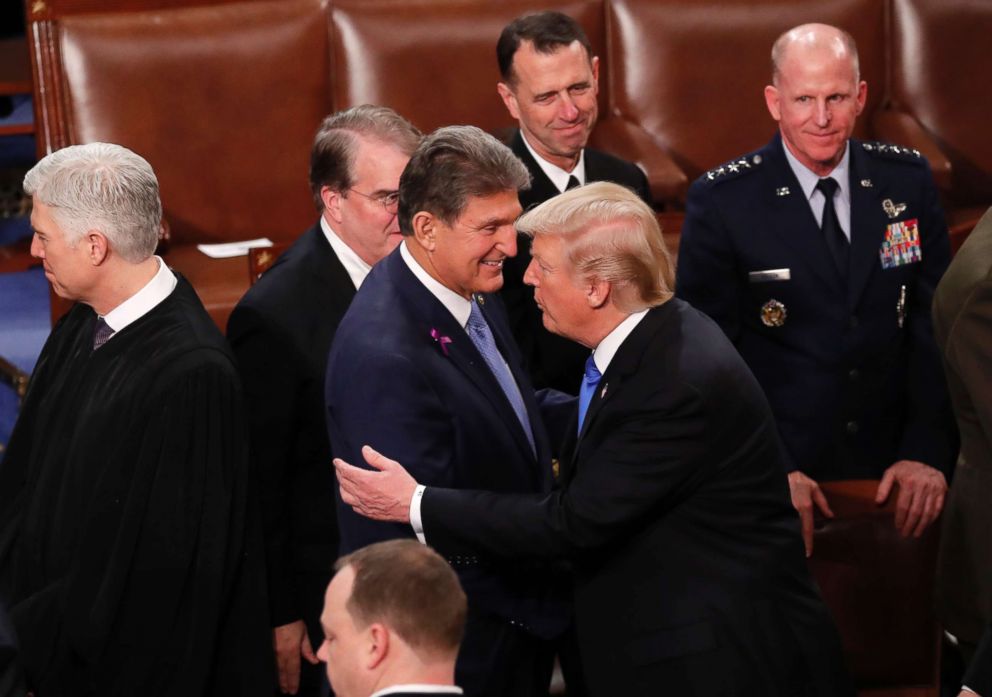
trump-manchin-rt-hb-180131_10x7_992

When the Senate impeachment trial wraps up, a supermajority of 67 votes will be necessary for the president to be removed from office.

The math indicates that even if all 47 Democrats in the Senate vote to convict, 20 Republicans would still have to break ranks with their Party and their base in order for the Dem’s dream to actually materialize.

Unlike the House vote on the articles of impeachment, the Senate vote that will ultimately exonerate the president is likely to be bipartisan, with at least one Senate Democrat voting against the president’s removal.

Although attention has been focused on how so-called moderate Senate Republicans may vote, three Democrat senators may serve as potential swing votes in favor of the president.

Sen. Kyrsten Sinema (D-Ariz.) looms as a potential vote to acquit. Sinema has a somewhat centrist voting record, and the state that she represents went for President Trump in 2016.

The Arizona senator has not revealed what she thought about the case that was presented by House Democrats. However, as the first Democrat sent to the U.S. Senate from Arizona in 30 years, she is no doubt aware of the eyes that are fixed upon her.

Sinema voted with the GOP to confirm both Attorney General William Barr and Interior Secretary David Bernhardt. She also voted in the positive to confirm many of President Trump’s judicial nominees and to pass a bill that enhanced immigration screening and expedited the cases of those who lack valid asylum claims. Putting herself directly in the crosshairs of the far-left wing of the Democratic Party, Sinema voted against the Green New Deal.

Democrats still carry a grudge, when as a member of the House of Representatives, Sinema voted against the Iran nuclear deal that was put together in 2015 by the Obama administration.

Sen. Doug Jones (D-Ala.) is the most vulnerable Democrat senator on the ballot this year, as he seeks to win a full term after his upset victory in a 2017 special election in the solidly red state of Alabama. In 2016 Trump took the state by nearly 28 points. Jones will be seeking a full term in 2020.

The Alabama senator has voted to confirm the vast majority of the president’s judicial nominees. He has additionally voted in favor of appropriations that included border wall funding. He also voted against the Green New Deal.

An outside group aligned with President Trump has targeted Jones in an advertising campaign, which aired during the Senate impeachment trial. The ad, which is appearing on television and other digital platforms, features images of House Manager Rep. Adam Schiff, Speaker of the House Nancy Pelosi, and Rep. Maxine Waters discussing impeachment.

Jones has joined other Democrats in calling for witnesses and documents to be part of the Senate trial. However, he is aware that if he votes against the president at the conclusion of the Senate trial, his upcoming election chances are likely to be negatively impacted.

The most likely of all Democrats to vote in the president’s favor is Sen. Joe Manchin (D-W.Va.), who was once considered for a cabinet position in the Trump administration. Manchin was the only Democrat to vote to confirm Supreme Court Justice Brett Kavanaugh in 2018. Displaying more support than any other Democrat senator, according to the website FiveThirtyEight, Manchin has voted with the president the majority of the time. And he, too, voted against the Green New Deal.

Not only does Manchin represent a state that President Trump won by more than 40 percentage points, he reportedly enjoys a friendly relationship with the president. He has been a guest at White House movie screenings and has lunched with the president. President Trump posed for pictures with Manchin, which were used in the senator’s 2018 campaign.

On Manchin’s urging, the president signed a bill into law in 2019 that dealt with pension and health care benefits for coal miners. After Manchin lobbied the president to do so, President Trump gave two basketball stars, Jerry West and Bob Cousy, the Medal of Freedom.

A recent Club for Growth poll of West Virginia voters indicates that almost 70 percent of those surveyed are opposed to the impeachment of the president.

Many Democrats have concerns about how Manchin will vote, but another issue may carry even more weight.

In December of 2019, Jeff Van Drew, a Democrat congressman from New Jersey, switched parties and became a Republican.

Manchin may find it’s the perfect time to follow suit.

Democrats Implement ‘The Big Reverse’

safe_image-14

“The Big Lie” is a form of propaganda that has been used over time by manipulative figures in and out of government, politics, and institutions. It has generally been adopted and applied with the specific intent to surreptitiously alter the beliefs of large groups of people.

Adolf Hitler utilized “The Big Lie” phrase in his 1925 book “Mein Kampf,” describing a lie that was so enormous in size those hearing it would be compelled to believe it.

As members of the human race, the positive side of our nature does not allow for us to accept the notion that any of our fellow human beings would ever lie to us in such a massively brazen way. Our line of reasoning, as well as our unconscious processing, leads us to believe that the lie we are hearing just may be the truth.

Hitler put it in the following way: “It would never come into their heads to fabricate colossal untruths, and they would not believe that others could have the impudence to distort the truth so infamously. Even though the facts which prove this to be so may be brought clearly to their minds, they will still doubt and waver and will continue to think that there may be some other explanation.”

And so it is that if the lie is big enough, people will oftentimes come to the conclusion that it is true, particularly if it is repeated over and over again.

Chiseled on an unholy invisible stone tablet, the insidious principle persists to this day. It was embodied in a quote from Hitler’s Minister of Propaganda Joseph Goebbels, which read as follows: “If you tell a lie big enough and keep repeating it, people will eventually come to believe it.”

Our customary psychological defenses endow us with the ability to filter out falsehood from truth so that we are able to deal with the commonplace types of lies that we encounter in everyday life.

However, “The Big Lie” is so extraordinary that it is able to pass through psychological defenses that exist within us. Our minds are temporarily short-circuited and ultimately manipulated to a sufficient degree that allows the lie to emerge as “truth.”

Various members of the Democratic Party have either wittingly or unwittingly come upon a variant of “The Big Lie,” which they have used in their “resistance” efforts against President Donald Trump, his administration, his personal relationships, and his family.

I have given this variant of “The Big Lie” the label of “The Big Reverse.”

Lying, of course, is part and parcel of “The Big Reverse.” However, “The Big Reverse” involves an additional component with an individual or group displaying a sudden and dramatic turnaround of language and conduct. This creates in the recipient population what media psychology refers to as “cognitive dissonance.”

Cognitive dissonance is an intellectual and psychological discomfort caused by the intake of information that involves a conflict between what has been said or done in the past and what is presently being said or done.

As human beings, we will instinctively seek to alter one of the opposing beliefs or behaviors to restore the sense of balance that needs to be maintained for individual stability and functionality.

How does all of the above information relate to where our country finds itself in a political, psychological, and societal sense?

Some recent examples may be instructive.

“Impeachment is a very serious matter. If it happens it has to be a bipartisan initiative,” Speaker of the House Nancy Pelosi stated in the spring of 2018. “Unless you have bipartisan consensus, impeachment is a divisive issue in the country.”

In an interview with The Washington Post in the early spring of 2019, Pelosi remarked, “I’m not for impeachment. Impeachment is so divisive to the country that unless there’s something so compelling and overwhelming and bipartisan, I don’t think we should go down that path, because it divides the country.”

Then the turnaround occurred.

It was the fall of 2019. Without a single Republican vote, the Democrat-controlled House of Representatives voted to approve an impeachment inquiry. Two hearings were then conducted, where partisan rules were imposed, restrictions were placed solely upon Republican committee members, witnesses that Republicans wished to call were denied, and evidence, fairness, and due process were ignored.

The Democrat-controlled House of Representatives brought the articles of impeachment up for a vote. Not a single solitary Republican voted in favor. In the most partisan way imaginable, the articles passed.

In another turnaround example, Democrats stoked the flames of fear and anxiety for months about the urgency that existed to remove the president from office. They even used the culturally familiar phrase “clear and present danger.”

Democrat committee chairs Adam Schiff and Jerrold Nadler had pushed through the proceedings without having waited for the judicial branch to decide on the legality of the president’s assertion of executive privilege.

After the articles passed the House, Pelosi suddenly put on the brakes. Shirking her constitutional duty, she held back the articles from the Senate for almost a month.

During the impeachment process, the Democrats went to great lengths to portray themselves as being “prayerful” and the process itself as being a “solemn” and “somber” one.

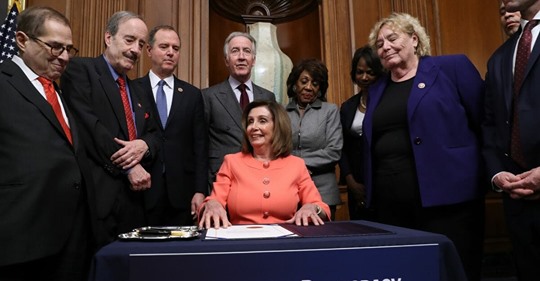
Then the impeachment signing ceremony happened.

Pelosi and her Democrat colleagues celebrated with abandon. Pens with Pelosi’s name stamped on them were actually handed out as souvenirs.

This caused a bit of short-lived cognitive dissonance on the part of otherwise Democrat-adoring personalities on cable news shows.

CNN’s Dana Bash commented, “We are used to seeing signing ceremonies handing out pens at moments of celebration, when a president is signing legislation.” She added, “It was unusual to see that kind of ceremony and handing out the pens and smiling for a picture in this kind of situation where the House speaker has bent over backward to say publicly and privately that this is somber, this is not a time for celebration.” And Bash’s colleague Nia-Malika Henderson called the odd festivities “a little jarring and certainly off message…”

Note of caution in the upcoming days: Expect to see more use of “The Big Reverse” in the Senate impeachment trial.