John Wayne Becomes Social Media’s Latest Target

jwayne1

Social media trolls recently honed in on a new target of attack. The same agitators that consistently seek to tear down statues, ban books, and silence dissidents have now dug up an interview with legendary actor John Wayne, which appeared in a May 1971 issue of Playboy Magazine.

What are Wayne’s detractors aiming for?

Well for starters, they want to change the name of the airport that is located in Orange County, California and bears Wayne’s name. Presumably the 9-foot bronze statue of the famed figure that stands at the entrance would be knocked down as well.

Even though Wayne is no longer with us and thus unable to defend himself, the transforming America crowd who are attempting to destroy Wayne’s reputation will not be satisfied until the movie icon’s legacy has been completely redacted from Hollywood history.

Screenwriter Matt Williams used his Twitter account to publish portions of the 1971 interview of Wayne, and re-tweeters managed to push the post into the viral zone.

Although some of the quotes in the interview appear to be inappropriate when examined within the context of today’s more enlightened cultural prism, at the time of the interview Wayne, along with many of his contemporaries, spoke in a blunt and occasionally harsh style both on and off screen, which was part of a projected character image.

Williams attacked the movie icon personally in a profanity laced social media post.

“Jesus f—, John Wayne was a straight up piece of s—,” Williams tweeted.

Comments to various re-tweets seemed to be at odds, with some agreeing with Williams and others urging a consideration of conversational context as well as the era in which Wayne lived.

Wayne was a man who before becoming a film icon was known as Marion Morrison, a football star at Glendale High and later at USC. He called the Golden State his home from the age of ten on and in later years was intimately involved with the once-sleepy county just south of Los Angeles, which grew in size and stature and came to affectionately be known simply by its initials, the OC.

Wayne’s fame transcended the norm of the conventional movie star and rose to a level that few ever achieve – that of enduring icon. However, Duke had something all his own. His movie star identity was wrapped up in the symbolism, beliefs, and ideals of the country he adored.

In a tell of a great artist, Wayne was able to capture the emotions that people felt about their country and place them on the big screen in all their Americana glory. His stories were their stories, perfected in a way that only Hollywood at the time could.

Interestingly, Wayne was an outspoken conservative and anti-communist. During the Playboy interview, he queried aloud, “What kind of a nation is it that fails to understand that freedom of speech and assembly are one thing, and anarchy and treason are quite another, that allows known Communists to serve as teachers to pervert the natural loyalties and ideals of our kids, filling them with fear and doubt and hate and downgrading patriotism and all our heroes of the past?”

Wayne’s popularity and influence on the American mindset disturbed Russian dictator Joseph Stalin to the point that the Soviet despot ordered an attempted assassination of the actor that auspiciously never materialized.

According to Michael Munn, film historian and author of “John Wayne – The Man Behind the Myth,” back in the early 1950s Stalin ordered the KGB to assassinate Wayne because he considered his anti-communist rhetoric a threat to the Soviet Union.

In 1959, when Soviet leader Nikita Khrushchev came to the United States, the autocrat had two requests he wished fulfilled: to visit Disneyland and to meet Wayne.

When Japanese Emperor Hirohito visited the United States in 1975, he also asked to meet Wayne, who was viewed as the personification of the American spirit.

Wayne’s iconic American status was recognized by the U.S. government, granting him the two highest civilian decorations in existence. In 1979 Wayne was given the Congressional Gold Medal, and in 1980 he was posthumously awarded the Presidential Medal of Freedom by then-President Jimmy Carter.

The legendary film star was nominated for three Academy Awards and was a one-time winner in 1969, taking the Best Actor in a Leading Role trophy for “True Grit.”

Despite attempts on the part of the left to characterize him as a bigot, the truth is Wayne was married three times and the three women he married were Latinas: Josephine Alicia Saenz, Esperanza Baur, and Pilar Pallete. In the wake of the coverage of the Playboy interview, Wayne’s family released a statement to the press.

“We hope America remembers John Wayne as we do: a devoted family man, great friend and cherished actor on the big screen, as well as for his continuing work to find a cure for cancer through the John Wayne Cancer Foundation and the John Wayne Cancer Institute,” the statement read.

“It’s unfair to judge someone on something that was written that he said nearly 50 years ago when the person is no longer here to respond,” the statement continued. “Regardless of color, ethnicity or sexual preference, [our] father taught us to treat all people the same, with respect.”

The outrage industry is on an endless quest to secure the next individual to impugn. As a result of the social media’s stoking of the fire, a virtue-signaling editorial was recently published by the Los Angeles Times, advocating that Orange County’s John Wayne Airport be renamed.

A formidable task awaits those who wish to erase Wayne from the public square, though. In addition to the airport in Orange County, opponents will also have to contend with a 21-foot bronze statue in Beverly Hills, which displays Wayne on horseback.

There is also a John Wayne Marina near Sequim, Washington, a 100-plus-mile trail named the “John Wayne Pioneer Trail” in the Iron Horse State Park, which is also in Washington, the John Wayne Elementary School in Brooklyn, New York, which features a 38-foot mosaic mural depicting “John Wayne and the American Frontier,” and the John Wayne Parkway, which runs through Maricopa, Arizona.

Oscars Ratings Woes Continue

91st Annual Academy Awards, Show, Los Angeles, USA - 24 Feb 2019

This year’s Oscars should have been a win for Hollywood, but trouble still follows Hollywood’s once prestigious annual event.

According to preliminary figures, ratings for the 91st Academy Awards were up slightly. Unfortunately, it is not enough to assuage anxiety over the awards show’s downward trend.

The second host-less Academy Awards ended up having the second-smallest audience in Oscar history. Audience size for this year was 28 million, according to the calculations of The Hollywood Reporter. This figure is up about 6 percent over the disastrous Kimmel-hosted show’s preliminary ratings of the previous year. Viewer-ship size was based on a 20.1 rating/33 share in metered-market households.

In 2018 box-office revenues seemed to have ticked up, and a lot of folks who were watching this year’s show had actually seen three of the Best Picture nominees: “Black Panther,” “Bohemian Rhapsody,” and “A Star is Born.” “Panther” took in a haul of more than $700 million in domestic gross, and “Bohemian Rhapsody” and “A Star is Born” each earned over $200 million. The success of the cinematic trio should have been enough to garner a larger audience than had been seen in the past few years.

It has been downright gloomy for those following the trend in ratings for the Academy Awards show. The overall concern over whether the Oscars were losing their allure was palpable. Last year’s show, which was hosted by Jimmy Kimmel, fell double digits from the previous year, sinking to the lowest ratings level for the show ever.

Although the ratings of all awards shows have been on the decline, Disney-owned ABC had to have been alarmed when it learned that viewer-ship for the 2018 Oscar show had dropped 25 percent in the key 18 to 49 demographic.

This year the Academy of Motion Picture Arts and Sciences tried a number of different things to give the sagging ratings a jumpstart. It released a series of proposals, all of which received significant backlash with the end result being the same – a cave by the Academy at the first sign of pushback.

In late 2018, the Academy came up with an idea for a new category that would grant awards to “popular” films. The thinking was to try and include nominees and winners that movie fans simply adored, thereby creating more buzz and bringing in more viewers. The blowback by film artists of all types was fierce, and the Academy relented.

The Academy tried picking a popular host that might prove to be a ratings magnet. It reached out to the highest paid actor currently in the industry, Dwayne “The Rock” Johnson. However, The Rock’s shooting schedule got in the way so the pick was a no-go.

Oscar leadership then turned to another popular Hollywood figure, Kevin Hart. The attempt to secure the mega-successful comedic actor turned into a PR debacle for the Academy. Hart had a decade-old tweet history that came back to haunt him. Once again the leadership couldn’t handle the flack that it received. CEO Dawn Hudson reportedly telephoned Hart to ask him to apologize for his past Twitter posts. This infuriated Hart, and he ended up withdrawing from the hosting gig, leading to the decision to broadcast a host-less telecast for the first time since 1989.

Then there was the time issue. For years, ABC-Disney had been pleading with the Academy to shorten the length of the Oscar telecast. The Academy leadership came up with an arrangement to abbreviate the normally long-winded telecast by awarding four of the ceremony’s prizes during the commercial breaks and then craftily editing the award winners into a later show slot.

Although the Academy believed that consensus for the plan could be developed by showing representatives from various branches a video demonstration of the newly conceived format, a high profile rebellion caused the Academy to reverse itself. Major creative players in movies, which included Spike Lee, Martin Scorsese, and Quentin Tarantino, signed an open letter condemning the idea. A few short days later the Academy melted.

Producers of this year’s show were able to cut 35 minutes from the overall length, when compared to the previous year. This was done by eliminating montages and mid-telecast comedy. However, the telecast still ended up being about 3 hours and 20 minutes long.

A December 2018 Morning Consult/The Hollywood Reporter survey found that ABC and the Academy were correct in their attempt to shorten the Oscar telecast. Forty-eight percent of adults said the Oscars telecast was too long.

A close second in annoyance terms to the overly long airtime of the Oscar show is the political content that is being pushed by Hollywood celebrities. The poll indicates that 39 percent of adults are less likely to watch awards shows when celebrities express their political views, and the number rises to 59 percent when viewers self-identify as Republicans.

Reportedly, in addition to the perpetually failing effort to shorten the duration of acceptance speeches at the Oscars, the Academy and producers of the telecast were apparently working hard behind the scenes to convince presenters and recipients of the awards to leave their politics at home.

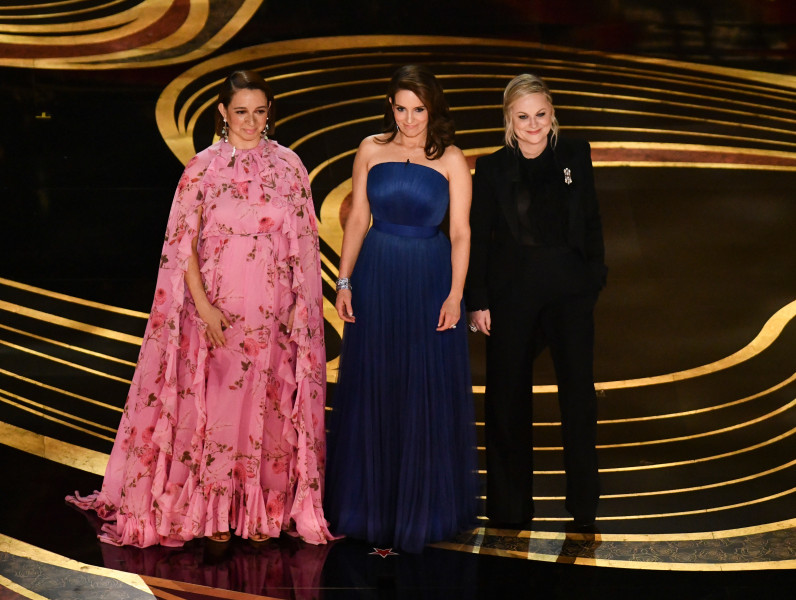
Well, it didn’t work. Tina Fey, Amy Poehler, and Maya Rudolph, the first group of presenters at the awards show, joked about the proposed “popular” film category, and apparently Rudolph could not restrain herself from tossing a political barb into her intro punch line.

“We are not your hosts,” Fey was quick to explain. Rudolph interrupted saying, “So just a quick update in case you’re confused. There is no host tonight, there will be no popular movie category and Mexico is not paying for the wall.”

Other presenters were quick to follow suit. While introducing the Best Foreign Language Film winner, actor Javier Bardem, who delivered his remarks in Spanish, took a veiled swipe at President Trump’s border security measures.

ABC translated Bardem’s speech in the following way: “There are no borders or walls that can restrain ingenuity or talent. In any region of any continent, there are always great stories that move us. And tonight, we celebrate the excellence and importance of the cultures and languages of different countries.”

Following Bardem’s comments, comedian Keegan Michael Key placed an open umbrella on the ground, imitating the president’s actions in 2018 prior to boarding Air Force One.

During his acceptance speech for Best Adapted Screenplay, director Spike Lee jumped into campaign mode in making a pitch for the 2020 presidential election, saying, “Let’s make the right choice, let’s be on the right side of history.”

“The 2020 election is right around the corner,” Lee said.

President Trump’s Emergency Declaration Will Survive Lawsuits

190215-pelosi-schumer-al-1242_d3bca321ca33f114f80bd0bde830735a.fit-1240w

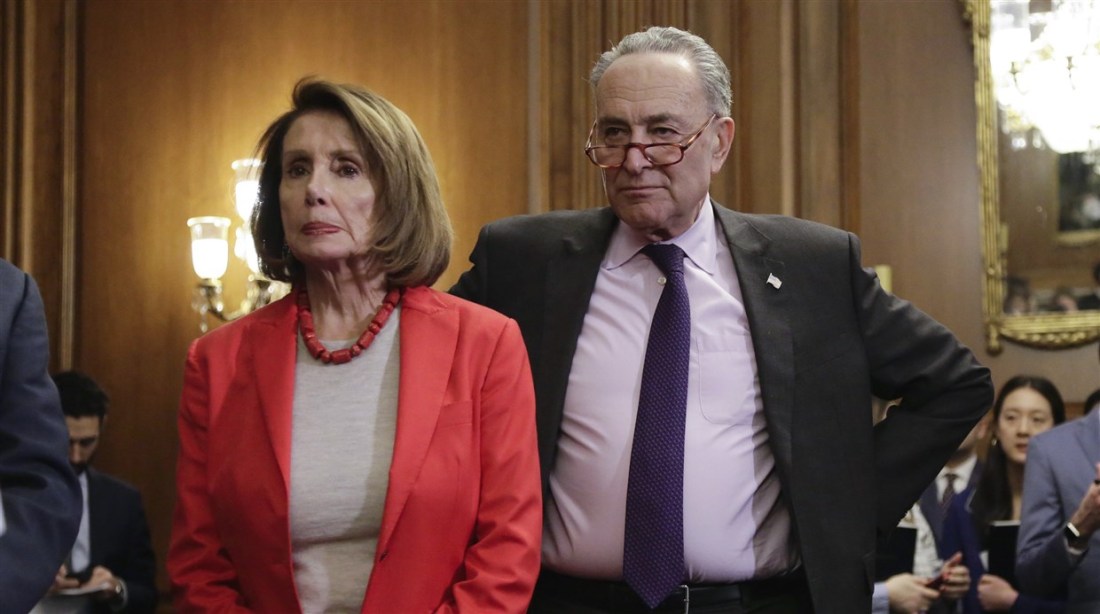
According to Rep. Adam Smith (D-Wash.), the new Chairman of the House Armed Services Committee, President Donald Trump possesses the lawful authority to use emergency powers to fund and build a barrier at the border.

In response to an interview question about the legality of the president’s recent emergency declaration, Smith told host of ABC’s “This Week” George Stephanopoulos, “Unfortunately, the short answer is yes. There is a provision in law that says the president can declare an emergency. It’s been done a number of times…” The congressman added that the president would be the recipient of a court challenge.

The lawsuit avalanche has just begun. More than a dozen states are filing suits challenging the emergency declaration. A case in point is the recent one declared by California Attorney General Xavier Becerra.

It is simply a fact that under existing law the suits should eventually lose when the U.S. Supreme Court ultimately gets the case.

Even Democrats such as Smith and various liberal legal commentators have admitted that President Trump has the statutory authority to declare the border crisis to be a national emergency, and he will therefore be able to adequately fund a border barrier.

The declaration by a president of a national emergency is nothing new. There have been 58 national emergencies declared since the National Emergencies Act of 1976 (NEA) was signed into law. Currently, there are 31 active national emergencies in effect. President Bill Clinton declared 17, and President Barack Obama declared 13 of them.

National emergencies exist today in remote places such as Yemen, Lebanon, Zimbabwe, Sierra Leone, Burundi, Myanmar, and Somalia. The current national emergency declared by President Trump deals with a crisis occurring on the U.S. Southern border.

The NEA was originally passed to rein in the authority of the president to use emergency power. The law requires the occupant of the Oval Office to renew declarations of emergencies annually, and it gives Congress the potential ability to terminate a state of emergency. Congress has routinely renewed most past declared emergencies without raising meaningful objections or litigation.

In order to terminate President Trump’s recent declaration of emergency, Congress must pass a joint resolution and submit it to the president for his signature. If the president were to veto the resolution, as President Trump would most certainly be expected to do, Congress would have to come up with a veto-proof supermajority to end the state of the emergency.

When Congress, via the NEA, granted the president the power to declare a national emergency, it did not define the meaning of the phrase. The power of any president to declare a national emergency ends up being very broad.

President Trump’s authority to do so does not arise solely from the NEA, though, but also from the presidential power to protect the nation and control the orderly process of entry into the United States.

Supreme Court precedent recognizes the power of the executive branch to control the admission and exclusion of foreign nationals and generally views this authority as mostly unsusceptible to interference by courts.

The funding for a border barrier has already been given the blessing of Congress via enacted legislation that was signed into law. The law of the land, as stated in the Secure Fence Act of 2006, is that a border barrier shall be built along the U.S. Southern border.

Democrats are alleging that President Trump’s emergency declaration is seeking to use an emergency as a means to obtain what Congress had refused to authorize. However, Democrats are evidently more than willing to have the judicial branch step in to end a declared emergency, rather than follow a law that specifically states how Congress is mandated to carry out the process of overriding an emergency declaration.

There was no mass rush to file lawsuits and no cries of abuse of power on the part of Democrats when President Obama, after stating that he did not possess the legal authority to do so, proceeded to bypass Congress after it refused to pass immigration reform. He simply created with a stroke of his pen a program that fundamentally altered immigration laws.

The former president additionally funded some significant parts of the Affordable Care Act, after Congress had denied him such funding. And he also funded the undeclared war in Libya, after Congress had turned down his funding request.

In is clearly apparent that Democrats are not concerned with the law, but rather they are in opposition to any kind of border barrier of which President Trump might be in favor. This is simply due to the fact that President Trump made the wall a centerpiece promise during his 2016 presidential campaign. Democrats have been relishing in anything they believe might harm him politically, and they continue to do so.

The ugly reality is that the primary reason Democrats are seeking to stop the construction of any type of border barrier is that barriers work, and they do not want anything to be implemented that might curb the mass migration of their would-be voters.

Jeff Bezos’s Extortion Claim May Go Nowhere

600x-1

Founder of Amazon Jeff Bezos, the richest man in the world, entered the political arena about six years ago with his purchase of The Washington Post.

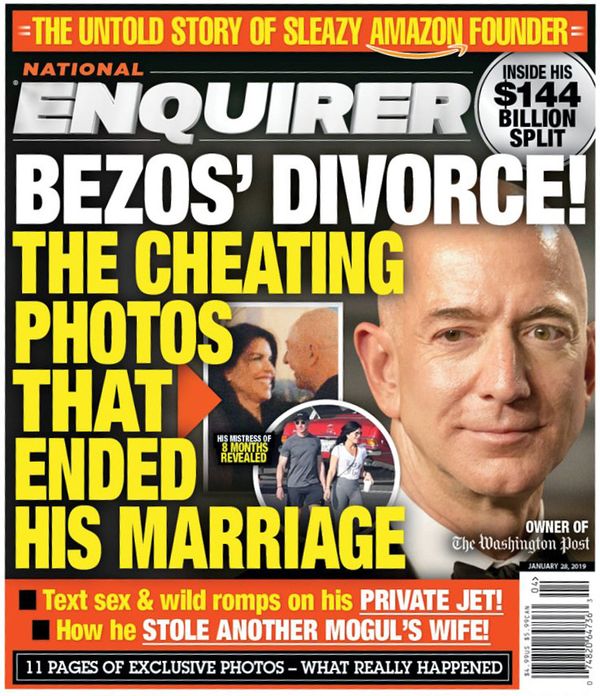
American Media, Inc. (AMI) is the company that owns The National Enquirer, which is the media outlet that recently revealed Bezos was involved in an extramarital affair. The Enquirer story appeared a day after Bezos announced that he and his wife of 25 years were getting a divorce.

The story exposed Bezos’s affair with Lauren Sanchez, who is a former host of Fox’s “So You Think You Can Dance.” News of the affair changed public perception of Bezos, particularly with regard to his image as a CEO.

After suffering some embarrassment as a result of the story, Bezos unveiled a surprising blog post, which accused AMI of extortion. According to Bezos, in an email sent by the company’s lawyer, AMI threatened to publish texts and compromising photographs of Bezos, which included pictures of his male anatomy, if he did not publicly state that the tabloid’s reporting on his affair was not motivated by political concerns. Ironically, the lawyer who wrote the email is a former Amazon employee.

David Pecker is the CEO of AMI, and he is known to be an associate and friend of President Donald Trump. In the aforementioned blog post, Bezos made it a point to mention President Trump and cited ways that the president and Pecker had cooperated in the past.

Apparently, Bezos has been stung by the president’s tweets about his newspaper.

“It’s unavoidable that certain powerful people who experience Washington Post news coverage will wrongly conclude I am their enemy,” Bezos wrote. “President Trump is one of those people, obvious by his many tweets.”

Bezos has now put together a team of prominent lawyers and crisis managers to assist him in his public tug-of-war. The team includes high-profile figures such as Hollywood lawyer Martin Singer, who in 2005 represented Bill Cosby over potential Enquirer articles that detailed sexual assault allegations made against Cosby.

Attorney Jonathan Sherman, who previously represented AMI, is part of Bezos’s team and is with the law firm Boies Schiller Flexner. Partner of the firm David Boies defended Harvey Weinstein against sexual harassment and abuse accusations.

An additional team member is security specialist Gavin de Becker, who worked with public figures such as Olivia Newton-John, Cher, and former President Ronald Reagan.

If the email is taken at face value, it appears as though AMI’s lawyer offered to forego the publishing of material that would be embarrassing to Bezos in exchange for a public statement from Bezos that would benefit AMI. Based on a superficial read, the subject of criminal extortion has been repeatedly featured in media discussions.

Citing anonymous sources, reports have surfaced claiming that federal prosecutors are looking into the extortion claim.

The allegation in question is that AMI, via its lawyer, communicated to Bezos during settlement discussions that it possessed embarrassing texts and photographs, and conveying that if Bezos did not settle with AMI the company intended to go forward and publish the material.

The communication was made by a Deputy General Counsel for AMI and purportedly followed an email from AMI’s Chief Content Officer that had described in detail the texts and photographs.

In analyzing this email, it is important to focus on the context within which both parties are seeking to settle a dispute.

In settlement negotiations, it is common practice for the parties to propose that each side will release the other from any potential claims. This is what was communicated through its legal counsel in the subject email by AMI, along with a proposal that Bezos would agree to tell the public that AMI’s coverage of Bezos was not politically motivated. In return, AMI would agree not to publish the texts and photographs.

Outside of the settlement discussion context, criminal extortion would exist in a case such as this if money was demanded as payment for not making public an embarrassing secret. However, in this instance the key difference revolves around the settlement backdrop.

Why would the two sides be negotiating a settlement? It is clear that Bezos has been raising potential civil legal claims against AMI, while AMI has suggested that Bezos’s Washington Post planned to publish a false news story about AMI.

These cross assertions are arguably the basis for both parties to be pursuing a settlement of their respective claims. A settlement agreement would mutually release the claims of both parties.

Typically such agreements contain non-disclosure provisions stipulating that neither side will disparage the other, particularly when both sides are publishers. The argument of AMI as a criminal extortion defendant would be as follows: the texts and emails in question were an essential part of the settlement negotiations and were necessary to establish an incentive for Bezos to negotiate.

Prosecutors would have an uphill battle in attempting to use these facts as a basis for a criminal extortion case. Additionally, the First Amendment creates further problems for the prosecution, since Bezos is a very well known influential public figure and a power player in Silicon Valley, Washington, D.C., and Hollywood.

Since Amazon moved forcefully into the entertainment business, Bezos is often seen at award shows and red carpet events. His life choices can have an on one of the largest companies in the world and one of the most influential news outlets in the nation. Despite its inherent unseemly nature, this story is, in fact, a newsworthy one that most current news outlets would run with if given the opportunity.

Furthermore, in the Michael Cohen case AMI entered into a non-prosecution agreement with federal prosecutors from the Southern District of New York, agreeing to cooperate in exchange for not being subjected to prosecution. The agreement was conditioned on the company not getting into trouble legally for a period of three years.

Bezos’s team is well aware that, if it were determined that AMI broke the law, the company would potentially be in violation of the agreement. However, if there is no prosecutable crime, there seemingly would be no impact on the non-prosecution agreement.

Much of the analysis and reporting on the latest chapter in the Bezos saga illustrates the hunger on the part of many in the mainstream press for anything that can be weaponized against the president and used to ratchet down his poll numbers.

Jerry Seinfeld Sued over Sale of Alleged Fake Porsche

DCc--LuW0AEs9BR

Jerry Seinfeld has just been sued over claims that he sold a company a rare vintage Porsche Carrera sports car that allegedly turned out to be a counterfeit.

The lawsuit against Seinfeld alleges that when the comedian auctioned off the classic car for a winning bid of $1.54 million, he knew that it was “not authentic.”

Seinfeld’s lawyer, Orin Snyder, has denied the claims and called the suit “frivolous.”

An entity called Fica Frio Limited bought the vehicle in March of 2016 at an auction that took place in Amelia Island, Florida. Seinfeld himself was allegedly in attendance at the auction.

In a complaint filed in a Manhattan federal court, the car is identified as a 1958 Porsche 356 A 1500 GS/GT Carrera Speedster, which was sold at an auction that featured the “Jerry Seinfeld Collection” of cars. The lawsuit quoted Spike Feresten, who was the host at the auction.

Feresten also happens to be a former writer-producer for the “Seinfeld” television show and, as host at the auction, used a punch line that referenced the iconic sitcom.

“Jerry has been generous enough to let me drive an awful lot of his collection,” Feresten said. “And I can tell you: They’re real and they’re spectacular.”

Seinfeld’s current hit Internet show, “Comedians in Cars Getting Coffee,” displays his passion for classic cars combined with his love of stand-up comedy.

The auction summary of the Porsche indicated that it was “From the Jerry Seinfeld Collection” and was a “stunning example of a rare thoroughbred Porsche.”

The 1958 Porsche was marketed at the auction as “one of 56” with “lightweight aluminum panels,” according to the suit.

“This exceptionally rare 1500 GS/GT Carrera Speedster is surely among the finest restored examples of a highly sought-after four-cam Porsche,” the marketing material indicated.

Between 1955 and 1959, Porsche built 151 Carrera Speedsters, and less than 60 percent of the cars had the GS/GT trim that the plaintiff believed the car possessed.

According to the lawsuit, a year later in March of 2017, Fica Frio had the car evaluated by a Porsche expert who determined that it was “not authentic.”

The suit quotes a voicemail that Seinfeld allegedly left for the buyer in June of 2018.

“[I want to] offer my apology for this nuisance and assure you that you will be completely indemnified in full and not have to keep the car and get all your money back,” Seinfeld purportedly said. “I did want to apologize to you personally for that happening.”

The comedian allegedly added that his experts never suspected there was anything wrong with the car, according to the suit.

Seinfeld also purportedly said that he “would also love to know how your guys figured it out because…my guys did not I guess see anything amiss with the car when I bought it.”

Fica Frio claims that Seinfeld has not paid back the money, and the company desires to rescind the sale, giving the car back to Seinfeld, with the purchase price going back to the buyer. Perhaps even more important to settlement discussions, the lawsuit seeks punitive damages from Seinfeld, which in theory may be considerable.

According to Seinfeld’s attorney, “Jerry has been working in good faith to get to the bottom of this matter. He has asked Fica Frio for evidence to substantiate the allegations. Fica Frio ignored Jerry and instead filed this frivolous lawsuit.”

The attorney added, “Jerry consigned the car to Gooding and Company, an auction house, which is responsible for the sale. Nevertheless, Jerry is willing to do what’s right and fair, and we are confident the court will support the need for an outside evaluator to examine the provenance of the car.”

Determining the authenticity of vintage cars is not as cut and dried as it would appear. The vast majority of civil suits end in some sort of settlement between the parties.

In an interesting little twist, one classic episode of “Seinfeld” deals with a plot line that bears a resemblance with regard to the “authenticity” theme.

The George character on the TV show is about to purchase a 1989 Volvo sedan, but the car salesman talks him into buying a 1989 LeBaron convertible instead. The smooth talking salesman is able to get George to believe that the vehicle was previously owned by famed actor Jon Voight.

It turns out that the car was indeed owned by a Mr. Voight, who was not an actor but rather a periodontist, and happened to bear the same first name but with the alternate spelling of “John.”

As Seinfeld, via his attorney, attempts to obtain some leverage for the negotiation process, he might ask Jerry how George handled his bad “Voight” deal.

Netflix Gets a Hollywood Makeover

netflix-696x533

Netflix has just turned its back on the Silicon Valley tech firms in a move that signals a seismic shift in the entertainment business.

The streaming video giant pulled out of the Internet Association, which is the lobbying entity for web-based businesses, and locked arms with Silicon Valley’s nemesis, the Motion Picture Association of America (MPAA), Hollywood’s preeminent lobbying organization.

The Internet Association is a highly influential trade group that represents the biggest technology companies in the world, including Google, Facebook, and Amazon. The MPAA members are the six studio giants of Hollywood: Disney, Paramount, Sony, 21st Century Fox, Universal, and Warner Bros.

Although the tech firms of Silicon Valley and the entertainment companies of Hollywood have some common interests, they are on opposite sides when it comes to copyright protection and statutory immunities that are of benefit to Internet intermediaries.

Because of recent data scandals and charges of censorship by the largest tech firms, U.S. lawmakers are raising questions about two existing statutes: 1) Section 230 of the Communications Decency Act, which shields Internet concerns from liability for content published by their users; and 2) The safe harbor provision of the Digital Millennium Copyright Act, which helps to protect such firms from copyright claims.

Hollywood, via the MPAA, has been pursuing more severe anti-piracy measures in an effort to prod Internet intermediaries into taking steps to prevent and remove illegal content that has been uploaded by users.

Immediately after Facebook CEO Mark Zuckerberg made an appearance in Washington, D.C. before a congressional committee, MPAA head Charles Rivkin requested that Congress begin looking into the possibility of holding Internet platforms accountable, which, of course, raised the specter of government regulation.

Rivken’s rhetoric infuriated Internet Association’s Michael Beckerman, who characterized the MPAA leader’s calls to regulate Internet companies as “shameless rent-seeking.”

Netflix is looking to the MPAA to assist in helping the streaming company expand into markets that in the past have proven to be difficult, if not impossible, to penetrate, which has been especially true with regard to China and India.

Netflix gradually morphed into a different entity from what it was at its onset. In the beginning, Netflix was a streaming platform that hosted third-party content and served as an alternative to Blockbuster and other video rental stores. The Netflix of today, though, is a full blown mega-studio, having reportedly spent about $13 billion on content just last year. Its service seeks to actively pair up content with needs and preferences of its subscribers.

In a recent letter to investors, Netflix CEO Reed Hastings indicated that because of the company’s success in producing original content, it plans to move away from outside programming and make content production the company’s primary objective.

Once dismissed by the industry as an entertainment flash in the pan and a mere rerun platform, Netflix has reshaped the way in which the public consumes entertainment. The industry realized that Netflix had become a threat to traditional entertainment business models, so CEOs sought comfort in mega-mergers and the establishment of new streaming services.

AT&T acquired Time Warner, and the newly formed entity presently has plans to launch a streaming service later in the year. Disney is also set to launch a streaming service, following its pending acquisition of 21st Century Fox. And Comcast will reportedly get into the streaming service business as well, after its acquisition of NBCUniversal is completed.

Netflix recently shocked its subscribers with its biggest price increase ever. A recent survey by Streaming Observer and Mindnet Analytics reveals that Netflix might lose up to 27% of its subscribers due to the price hike.

Another factor that poses a threat to Netflix’s bottom line is that major streaming service competitor Hulu reportedly has plans to lower its monthly charge from $7.99 to $5.99, starting at the end of February 2019.

Netflix is likely to lose much of its licensed third-party content at approximately the same time that Disney’s much-anticipated streamer is launched, complete with entertainment fare from its “Star Wars,” Marvel, and Pixar catalogues.

The current corporate model of Netflix is predicated on rapid growth. However, it now looks as though Netflix will have the brakes applied as emerging competition from Hollywood causes the streaming business to go through a remake.

Gladys Knight Takes a Stand for the National Anthem

gettyimages-1048514638

Gladys Knight earned the nickname “Empress of Soul” for good reason. The hit songs that she and her band mates, the Pips, delivered throughout the 1960s, ‘70s, and ‘80s left a unique gospel-pop imprint on the pages of American music history.

It is for this and so many other reasons that Knight seems to be the perfect voice to lend dignity and beauty to professional football’s great national anthem moment this year.

Super Bowl LIII is set to take place on February 3 in Atlanta, Georgia, where the Los Angeles Rams and New England Patriots will battle to determine which team will ultimately secure the coveted Vince Lombardi Trophy.

Look for “The Star-Spangled Banner” performed by Knight to provide a graceful air of decorum to the pre-game ceremony and give an assist to a National Football League (NFL) in need of an image boost after suffering through the aftermath of some high-profile political posturing.

Knight began singing at the tender age of four. By age seven, she had secured a win for an appearance that she made in 1952 on “Ted Mack’s Original Amateur Hour.”

The following year Knight’s family formed a musical group, which they dubbed “the Pips,” a name derived from that of a cousin of Knight, James “Pip” Woods. The group would later come to be known as “Gladys Knight and the Pips,” which would be the vehicle that would ultimately propel Knight to superstardom.

Knight has an ecumenical faith background, having been born a Baptist, attended a Catholic grade school, and converted in the late 1990s to the Mormon church, the place in which she would create the Grammy Award-winning “Saints Unified Voices” gospel music choir.

The soul singer’s upcoming performance of the national anthem comes at a time following former member of the San Francisco 49ers Colin Kaepernick’s game setting launch of a political protest.

Kaepernick’s protest began in 2016, during the third pre-season 49ers game in which he sat (and in later games knelt), instead of standing up with his teammates and the stadium fans as the national anthem was sung.

Kaepernick’s mode of protest, which continued throughout the season during the pre-game singing of the anthem, was offensive to many and distinctly out of place. It ended up hitting the NFL hard in the pocketbook, as some football players attempted to show their support for Kaepernick by emulating him.

The demonstrations by dissenting players during the anthem infuriated a significant number of football fans. However, liberal Hollywood elites and like-minded media outlets collectively nodded in unison and proceeded to lionize the protesting players.

Sports attire giant Nike added fuel to the football fire by making Kaepernick the poster boy of a signature advertising campaign. Kaepernick remains embroiled in a grievance arbitration filed against the NFL in which he alleges that team owners colluded to keep him out of the league after he lost out to being signed last season.

The whole Kaepernick controversy spilled over into this year’s Super Bowl halftime show preparations. Virtue signaling became all the rage as performers, which included singer Rihanna as well as rappers Cardi B and Jay-Z, declared that they would boycott the halftime show. Jay-Z even placed the following line in one of his tunes: “I said no to the Super Bowl, you need me, I don’t need you.”

Meanwhile, those who are currently slated to perform, including singer and judge on “The Voice” Adam Levine’s musical group Maroon 5 and rappers Travis Scott and Big Boi, are being slammed by the social media and pressured to withdraw. Scott has even received backlash via Kaepernick’s own Twitter account.

Knight recently issued a timely and sage statement to the public, using a Hollywood trade publication as her outlet.

“I understand that Mr. Kaepernick is protesting two things, and they are police violence and injustice,” Knight wrote as reported by Variety. “It is unfortunate that our national anthem has been dragged into this debate when the distinctive senses of the national anthem and fighting for justice should each stand alone.”

Knight’s statement continued, “I am here today and on Sunday, Feb. 3, to give the anthem back its voice, to stand for that historic choice of words, the way it unites us when we hear it and to free it from the same prejudices and struggles I have fought long and hard for all my life.”

In light of the disharmony caused by the behavior and rhetoric on the part of Kaepernick and his allies in Hollywood and the mainstream media, coupled with the inept response by NFL leadership, Knight’s voice is going to be a musical tonic for those who have a passion for football and unabashed love for America.