Les Moonves’s Career at CBS Comes to an End

djis2e_uwaar4-y

In July of 2018, the New Yorker’s Ronan Farrow completed a detailed investigation, centering on sexual misconduct allegations from six women against CBS Chairman and CEO Les Moonves.

The women claimed that Moonves had propositioned and/or had forcible physical contact with them, threatened retaliation against those who had rejected him, and otherwise maintained a workplace in which sexual harassment went unabated.

Allegations put forth by the women suggested that a toxic culture existed at CBS. When the allegations went public, Moonves responded at the time with an acknowledgement that he was responsible for making “some women uncomfortable.” However, he denied claims that he had harmed the careers of those who had resisted him.

It looked as though Moonves was on his way to weathering the #MeToo storm. CBS had launched an investigation into the allegations in Farrow’s report. However, Moonves was allowed to remain on the job while the investigation of sexual misconduct proceeded, unlike many other figures who had been accused of sexual impropriety.

Then, like a series of aftershocks after an earthquake, an additional six women stepped forward, via reporting by Farrow, with accusations against Moonves.

The most recent alleged incidents of sexual misconduct purportedly took place over a span of 30 years from the 1980s to the early 2000s.

The additional claims against Moonves by the second group of women contain more serious allegations than those reported by Farrow earlier in the year. This latest set of allegations includes incidents in which the entertainment executive is alleged to have forced victims to engage in sexual activity, exposed himself to alleged victims, or used physical violence and intimidation against them. Some of the women also claim that Moonves retaliated against them professionally after they refused to comply.

Some of the more recent accusers have chosen to go on the record and shed their anonymity, including a television executive whose claims date back to the 1980s and a former assistant who recounted an incident from 1994.

In a statement to the New Yorker, Moonves acknowledged that three of the encounters occurred and claimed they were consensual. He flatly denied using his position in a retaliatory way to interfere with the careers of the women.

Under the circumstances, options appear to be limited in this case. The relevant statute of limitations does not allow a proceeding using criminal law, and obtaining witnesses and/or documents from thirty or forty years ago poses a great deal of difficulty.

What really caused Moonves’s tenure at CBS to end, prior to the conclusion of the investigations, were reports in numerous media outlets that negotiations were taking place concerning a proposed exit package for the television executive that involved a large dollar amount.

The most recent accusers were prompted in part to come forward due to the public reports of Moonves’s exit package, which was said to be valued at approximately $100 million.

“Many of the women found that very, very frustrating,” Farrow told CNN. “They felt this was a board that has let a powerful man who makes a lot of money for this company, in the words of one person, ‘get away with it.’”

The end result is that six weeks after Farrow published the first allegations against him and twenty-three years after he first joined CBS, Moonves has been forced out of the network.

However, the previously reported $100 million payment package to Moonves is likely to be eliminated or drastically reduced, due to the increased potential culpability relating to the allegations of the second group of women as well as the cumulative effect of the allegations of all twelve accusers.

CBS’s leverage against Moonves has been significantly increased because the company is now able to claim that the executive may be terminated “for cause.”

Significantly, the exit agreement reportedly also includes a settlement of the litigation between Moonves and Shari Redstone, the controlling shareholder of both CBS and Viacom. Moonves and Redstone had been in a heated legal battle over whether to combine CBS and Viacom, with Redstone urging a merger and Moonves resisting such a move.

With Moonves gone, the merger is highly likely to take place in the very near future.
Antitrust Law Should Be Used to Break Up Big Tech Monopolies

161214-trump_techexecutives-1558_539e73df73d2409411e78c0f502b8ce3-fit-1240w

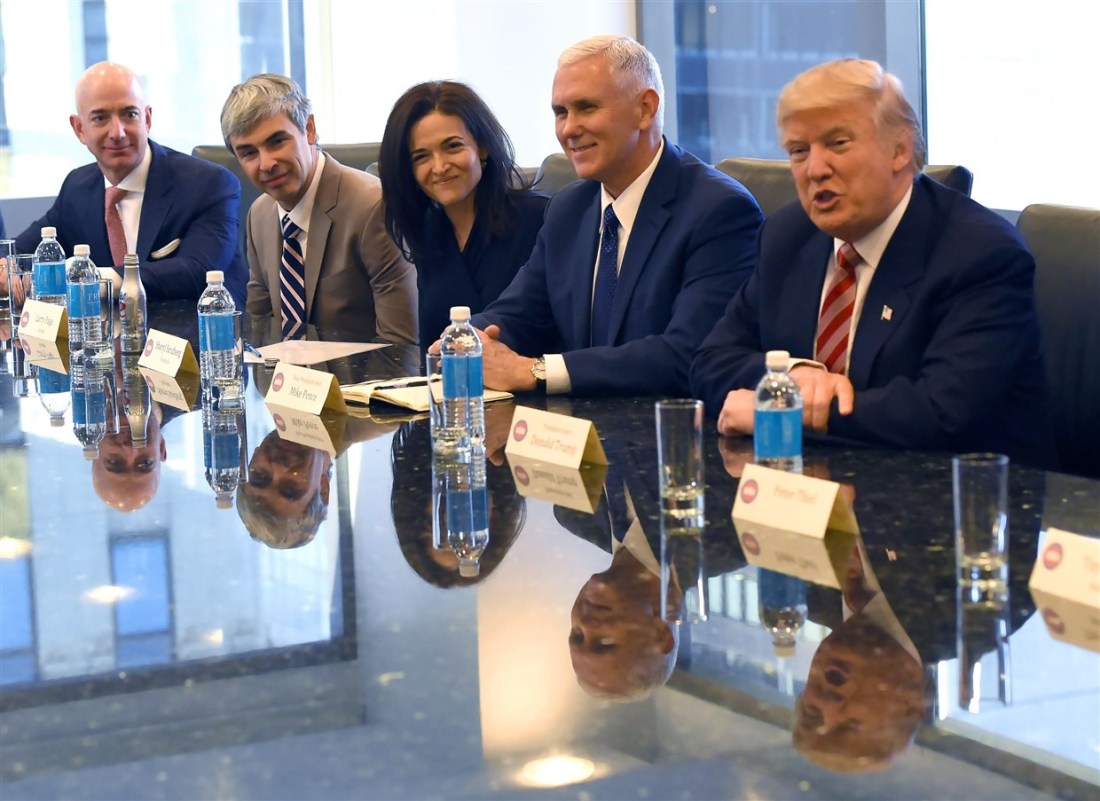
President Donald Trump, via his Twitter account, recently prompted a public discussion about the possibility of using antitrust law against major technology companies, due in part to a growing body of evidence that bias is being perpetrated against conservative individuals and entities by such companies.

The primary rationale of antitrust enforcement is the protection of the American consumer and free market economy from unprincipled business behavior by monopolistic enterprises.

Never before in the nation’s history have companies, such as Google, Facebook, and Amazon, among others, possessed the size, wealth, dominance, control, and sheer power that the tech giants do.

With more than 70 percent of the PC search market and almost 85 percent of the mobile device market, Google currently has a virtual stranglehold on the gateway to digital information. And Google’s video social media platform, YouTube, controls almost 80 percent of the video market.

Facebook has about 2 billion users worldwide, and when the company’s additional acquisitions of Instagram and WhatsApp are factored in, 95 percent of young people regularly log on to Facebook platforms.

When it comes to Amazon, by the year’s end the company will have swallowed up almost 50 percent of the U.S. e-commerce business, and additionally lays claim to 80 percent of the e-book market. Amazon is also the largest provider of hosted cloud services, and the odds are strong that an online sales firm that competes with the company would likely be using Amazon servers for its own website.

Research on Google searches has produced data, which indicate that bias against conservative news outlets, blogs, and websites exists, and additionally indicate that ideologically right-of-center content has actually been removed from YouTube.

Despite Google’s denial of bias, PJMedia recently conducted a count of search results relating to President Trump and found that 96 percent of the most visible news articles that arose were generated from liberal outlets.

The Daily Caller reported that Google’s fact check feature engages almost exclusively in the targeting of right-of-center sites.

Facebook has exhibited bias in its trending topics, as well as in its removal of conservative content, and Amazon has manipulated book reviews to favor leftist writers.

Despite promises to the contrary, Facebook continues to censor ideas based on conservative content and has recently been caught doing so. A New York Post article by Salena Zito, which noted that supporters of President Trump were unaffected by the conviction and plea deal of two prominent Trump-associated individuals, Zito’s article was labeled as “spam.”

Facebook even took down an article titled “The School Shootings That Weren’t,” posted by NPR, that showed the number of school shootings, which were claimed to have taken place during the 2015–2016 school year, was highly inflated.

The president is correct in suggesting that the use of antitrust law against tech companies may be a necessary step that the government needs to take in order to awaken the tech giants to the duty that they have, to exercise greater responsibility in their approach to users and content. If they do not, consequences may result as seen with other companies, which were divided into smaller less monopolistic concerns.

In a previous antitrust filing, AT&T was split up into eight much smaller companies, and Standard Oil was divided into 34 firms. Each of these companies possessed the ability to almost totally dominate their respective market. The original AT&T accounted for 93 percent of all telephone calls made in the U.S., and Standard Oil sold 87 percent of U.S. refined oil.

An antitrust case that began in the early years of former President Bill Clinton’s administration was ultimately settled by the Department of Justice. Microsoft had been accused of abusing monopoly power on personal computers, in its handling of operating system and web browser sales, by bundling its Internet Explorer browser with its Windows operating system.

Microsoft’s actions are strikingly similar to a recent Google business practice. To insure its dominance of the mobile market, Google forced carriers and manufactures that used its Android operating system to make Google Search the default search engine and include a number of Google apps as well.

In 2008 the Bush Justice Department threatened to bring an antitrust action against Google, due to a proposed partnership with Yahoo for the sale of advertising. At the time, Google had a 70 percent share of the market, and Yahoo, with 20 percent, was the second largest search engine.

Due to the monopolistic realities of these giant tech companies, startups that might compete with the giants may end up being smothered. For example, an entrepreneurial startup company with products that compete with Google offerings has to be concerned that Google will give its own product a higher ranking and may even hide the new company’s competing products.

This poses a danger to the overall consumer market, because consumers lose the ability to become aware of and/or purchase any innovative products that startup companies might have to offer.

Both Google and Facebook maintain that their companies should not be the subject of antitrust scrutiny, because their product is said to be provided to their users free of charge. However, participants who are obtaining the services for free are not the actual customers of the companies. The real paying customers, in both search and social media, are the advertisers and publishers that pay for the ability to broaden their own pool of consumers.

The argument can be made that the big tech companies, via paid search advertising and paid social media advertising, have morphed into monopolies, and these monopolies have effectively stifled competition and innovation, while having a deleterious effect on the free market economy.

Probe by the Special Counsel Continues to Broaden in Scope

cbsn-fusion-trump-cfo-allen-weisselberg-immunity-deal-thumbnail-1642806-640x360

The Wall Street Journal recently broke the story that Allen Weisselberg had been granted immunity by federal prosecutors in the Southern District of New York.

Weisselberg is the longtime chief financial officer of the Trump Organization and also serves as the treasurer of the Trump Foundation.

The CFO has been with the Trump family since 1970, when he began working for President Donald Trump’s father, Fred Trump. Weisselberg currently co-manages the Trump businesses along with President Trump’s adult sons.

Weisselberg was called to testify to a grand jury earlier this summer. As the CFO, he presumably has a wealth of knowledge about the Trump Organization’s internal cash flow.

Presently, Weisselberg has been given immunity related solely to the payments that Michael Cohen made to two women with whom Trump allegedly had affairs. However, through use of the same above-described investigation, prosecutors could potentially subpoena additional records from the company, and the investigation could undergo a further expansion.

Through use of the offices of the U.S. Attorney for the Southern District of New York, it appears as though the legal team of Special Counsel Robert Mueller has obtained a foothold with which to examine President Trump’s private businesses activities.

A look at how the investigation initially came into existence helps to provide insight regarding the current direction of the probe.

In May 2017, through an order issued by Deputy Attorney General Rod Rosenstein, Mueller, a colleague of Rosenstein, was appointed to the position of special counsel, following the dismissal of FBI Director James Comey.

Questions about conflicts of interest arose, including those surrounding the situation in which Mueller had unsuccessfully interviewed for the position of FBI director the day prior to his appointment as special counsel. Mueller’s appointment materialized after a push had taken place, primarily on the part of Democrats, for Attorney General Jeff Sessions to recuse himself, and Sessions acceded to the demands.

The language used in the appointment of the special counsel was broad in scope and essentially gave Mueller carte blanche to investigate without restrictions or limits on length, breadth, and/or monetary considerations.

Mueller went on to assemble what appeared to be a highly partisan team, which included the following individuals:

-Senior prosecutor Andrew Weissmann, who attended 2016 Democratic presidential candidate Hillary Clinton’s election night gathering and also sent a congratulatory email to former Deputy Attorney General Sally Yates after she blocked the so-called travel ban that had been issued in the early days of the Trump administration;

-Jeannie Rhee, a lawyer who represented the Clinton Foundation and also worked for Ben Rhodes, a former Obama administration NSA deputy director;

-Aaron Zebley, who represented the individual who installed Hillary’s private email server and who was also involved in the destruction of some Blackberry devices;

-Peter Strzok, former Chief of the Counterespionage Section of the FBI, who had led the tepid FBI investigation into Hillary’s use of a private email server, and who also initiated the aggressive investigation of the Trump campaign, which led to the Mueller appointment;

-Lawyer Lisa Page, Strzok’s colleague and paramour, who had exchanged text messages that revealed a bias against then-candidate Trump. Both Page and Strzok were removed from Mueller’s team for public relations reasons, according to the testimony of Strzok.

In 2009 Harvey Silverglate penned the book “Three Felonies a Day: How the Feds Target the Innocent.” In the foreword to the book, Harvard Law School Professor Alan Dershowitz discusses his experiences litigating cases in the old Soviet Union. Dershowitz notes that, due to vague interpretations of Russian laws, anyone could be prosecuted. The professor reminds us that it was Lavrentiy Beria, the infamous henchman of Joseph Stalin, who assured the dictator of the following: “Show me the man and I’ll find you the crime.”

The investigation was born amid multiple misgivings, which included, among other things, dubious FISA warrants obtained with a dossier paid for by the Clinton campaign and the Democratic National Committee. Contributing to the cloud of confusion that continues to surround the investigation is the fact that from its beginnings it had been minus a mandate of a specific crime with which it had been tasked to investigate, and the investigatory team has continued in its growth pattern.

Anti-Trump Media Attempt to Tamper with the Manafort Jury

manafort-mueller-ap-er-180103_hpembed_2_4x3_992

Paul Manafort worked as a manager for the Trump campaign for approximately three months back in 2016.

A high-profile trial has been taking place over the last three weeks in the courtroom of Judge T. S. Ellis. Manafort has been charged with eighteen counts of income tax evasion and bank fraud. The jury in the case is presently deliberating.

Still smarting from the unexpected results of the 2016 election, many in the mainstream media have been feverishly covering each step of the investigation being conducted by Special Counsel Robert Mueller as well as the Manafort trial, which they view as the singular most important legal event for Mueller thus far.

However, two recent events that happened during the trial have seemingly generated concern and even anxiety within the mainstream media over the possibility that the trial’s outcome may not be the one for which the outlets had longed.

First, Manafort’s defense team rested its case without presenting witnesses or actual evidence of any kind, making it abundantly clear that the defense lawyers were taking the position that the prosecution had not met its burden of proof.

Second, while still in the process of deliberating, the jury asked four questions of Judge Ellis.

The first three questions dealt with relatively trivial matters concerning forms, exhibit lists, and such. However, the fourth question, which requested that the judge “redefine reasonable doubt,” set off waves of nervous discussion within mainstream newsrooms.

In this case, the burden of proof that rests on Muller’s shoulders is to present sufficient evidence so that the jury will be convinced beyond a reasonable doubt that Manafort is guilty of the crimes with which he has been charged.

By inquiring about the “reasonable doubt” standard, it could well be the case that the jury had been wrestling with the issue of whether or not the evidentiary burden had been met, which could indicate that a possible hung jury, or even an acquittal, is forthcoming.

Either of the above results would constitute a major blow to the already sinking reputation of the special counsel probe. The partisans that populate the newsrooms of the mainstream media would not be able to tolerate such a result.

This may explain why CNN, the Washington Post, BuzzFeed, Politico, the New York Times, NBC Universal, and the Associated Press sprang into action and had their lawyers file a motion to seek the release of the full names and addresses of every one of the jurors.

The timing of the request is extremely suspicious, and there is little, if any, newsworthiness in obtaining this type of information. The mainstream media were apparently unconcerned with the names and addresses of the jurors when they were selected weeks ago, yet they rushed into court to seek the unveiling of the jurors’ names and addresses on the day after the same jurors inquired about the meaning of “reasonable doubt.”

Fortunately, Judge Ellis ruled against the motion, and in the process revealed that he had personally received death threats and therefore had to be guarded by federal agents.

Judge Ellis also indicated that he was convinced that the jurors could be placed in harm’s way if their names and personal contact information were released. He additionally told the courtroom that the jurors were “scared” and “afraid.”

This jury has not been sequestered. The media outlets that filed the motion are fully aware that there is a high probability that the individual jurors will find out that a host of wide-reaching news organizations were seeking to expose their names and locations.

Manafort has a constitutional right to a trial by a jury of his peers. The jurors, who are fulfilling a civic duty, should have their personal privacy respected during the deliberation process. Outing the names of jurors would be an unethical and egregious interference with due process.

The Digital Threat to Free Expression

google-facebook-apple-spotify-big-tech-censorship-640x480

Recently, in a series of unprecedented moves on the part of four major social media platforms, free expression was deliberately brought to a halt.

That the thwarting of the free expression in question took place on the same day adds to the alarming nature of the action by the digital powers that be.

Alex Jones’s InfoWars content was banished from Facebook, Apple, YouTube, and Spotify. The move appears to have been a coordinated effort.

The removal of the content was evidently motivated by a desire to rid the platforms of supposed hate speech. However, the same platforms continue to display pages that have far more incendiary and/or offensive content than InfoWars posted.

Provocateur Jones’s site was a convenient quarry for tech companies to begin their purge of content that they subjectively deem undesirable.

However, tech giants have laid down a track record that indicates they cannot be trusted to maintain a fair venue for the marketplace of ideas.

Approximately 70 percent of the people within our country now obtain their news from Google and Facebook. Additionally, the major tech concerns have a virtual stranglehold on the manner in which billions of people around the globe communicate.

Truth be told, there has never been a more massive concentration of media power than that which is squarely in the hands of Google, Facebook, Apple, Twitter, and a smattering of other internet companies.

As digital companies go about the business of justifying censorship, many are looking for solutions via regulation.

Restraints on speech imposed by private companies are not protected by the First Amendment, and companies do not have a legal obligation to provide freedom of speech to their users. While internet companies were once fierce advocates of free expression, this is unfortunately not the case anymore.

Being larger than many governments of countries throughout the world, the tech giants act in a quasi-governmental manner when they eliminate or limit speech within their internet province.

Some have proposed turning the big tech giants into public utilities. Others have urged breaking up the companies through the use of anti-trust law, a logical idea when considering that the major tech firms have essentially become a monopoly with no significant competition, e.g., Google’s dominance of the internet video market and Facebook’s rule over the social media sector.

British Prime Minister Theresa May recently suggested that social media platforms be treated like news organizations, which would render them responsible for content appearing on their platforms.

Rep. Steve King has recommended revisiting the law that shields internet companies from being treated as the publisher of content users’ posts, thus restoring legal responsibility for defamatory and other tortious or criminal content that is published. The Iowa congressman is referring to a statutory provision that made the current internet social media landscape possible: Section 230 of the Communications Decency Act.

Publishers of content are typically liable for the material they disseminate, even when the content originates from individual unpaid contributors, such as a “letter to the editor.”

In 1996, when the web as we know it was still in its infancy, Congress passed the Communications Decency Act. An amendment to the original bill, Section 230, stated, “No provider or user of an interactive computer service shall be treated as the publisher or speaker of any information provided by another information content provider.”

The statute protected Internet providers from being deemed news organizations and gave legal immunity to the tech companies, ostensibly to foster industry growth and freedom of speech.

The U.S. Supreme Court stripped away much of the bill in 1998, but Section 230 was left unscathed.

Later precedents interpreted Section 230 broadly so that digital platform companies could grow exponentially, without serious concern for illegal speech placed on their platforms. And grow they did, to become the gargantuan companies that they are today, complete with secret algorithms that render selected users invisible. At the start, the young companies would not have been economically feasible minus the provision.

The law also prevents liability in the event “objectionable” material is removed. If the companies do choose to eliminate offensive user-created content, their immunity is not forfeited.

These massive companies are essentially being treated by the law as if they are still mere startups. Although many in the tech community see Section 230 as sacrosanct, i.e., not to be touched, the provision was modified by a bi-partisan coalition in Congress earlier this year. President Trump signed legislation amending Section 230 in April 2018, denying some legal immunity to internet platforms in order to fight sex trafficking.

More carve outs of the statute, or the threat of such, will get the attention of the tech giants and perhaps motivate them to return to the free and open platforms they once wanted to be.

Rebel Comics Rock, Seinfeld, Allen, Miller, and Brooks Speak Out

hwc4dxxwwrrz5jboo32v7edabq

Chris Rock has recently been attacked by the left because he tweeted some words of praise for his comedic colleague Jerry Seinfeld.

In his tweet, the comedian and filmmaker included a link to an article from The Federalist, titled “Seinfeld’s ‘Comedians In Cars’ Is A Welcome Respite From The Insufferable Wokeness Of Comedy.”

“Wokeness,” or the abbreviated “woke,” is the term that is being used by the so-called resistance movement to describe an individual or group’s commitment to oppose President Donald Trump.

Author of the article Ellie Bufkin argues that the value in Seinfeld’s show is that its emphasis on being funny, as opposed to actively engaging in leftist political messaging, “has created a wonderful escape from the political insanity of our day…”

As pointed out in the article, Seinfeld had been chastised by the Vulture website and others for not inserting “woke” politics into his show. Bufkin and Rock were essentially commending Seinfeld for not joining the ranks of the numerous late-night Trump bashers who in today’s cultural climate are delivering patently predictable comedy to their audiences night after night.

Further infuriating the left, Rock concluded his tweet with the following words: “Thank God for Jerry.”

Meanwhile comedic actor Tim Allen told Entertainment Weekly that the current politically correct restrictions imposed on public expression are posing an actual danger for comedians.

“It’s a very icy time. I’ve been a comedian for 38 years and I’ve never seen it, like Lenny Bruce said at the Purple Onion, ‘we’ve gone backwards,’” said Allen, whose series “Last Man Standing” is set for a return to television in September on FOX.

“There are things you can’t say. There are things you shouldn’t say. Who makes up these rules? And as a stand-up comic, it’s a dangerous position to be in because I like pushing buttons. It’s unfortunate,” Allen added.

Humor is an important relief valve for individuals as well as the whole of society, and in a cathartic manner allows people to observe new and differing perspectives on potentially polarizing topics. It is therefore critically important to examine the left’s penchant for weaponizing identity politics and the degree to which the strategy has resulted in the serious side effect of silencing laughter itself.

Human response to comedy is uniquely spontaneous. Comedian, actor, and best-selling author Dennis Miller wrote, “Laughter is one of the great beacons in life because we don’t defract it by gunning it through our intellectual prism. What makes us laugh is a mystery — an involuntary response.”

Today’s late-night comedians are often comfortable operating joke free, no longer seeking laughs but instead pursuing applause via material that panders to their like-minded niche audiences. In the same interview in which Rock told New York Magazine that he gave up performing at colleges due to hyper-political correctness on campuses, he talked about the manner in which technology and social media spur comedians to censor their own material.

Stand-up practitioners have a particularly pressing need to try out their material before exposing it to a larger audience.

“It is scary, because the thing about comedians is that you’re the only ones who practice in front of a crowd. Prince doesn’t run a demo on the radio. But in stand-up, the demo gets out. There are a few guys good enough to write a perfect act and get onstage, but everybody else workshops it and workshops it, and it can get real messy. It can get downright offensive,” Rock said.

The prevalence of smart phones, which have the capacity to record and share, has altered the way reactions to stand-up presentations are communicated.

“Before everyone had a recording device and was wired…, you’d say something that went too far, and you’d go, ‘Oh, I went too far,’ and you would just brush it off. But if you think you don’t have room to make mistakes, it’s going to lead to safer, gooier stand-up. You can’t think the thoughts you want to think if you think you’re being watched,” Rock added.

In comedy clubs back in the day, when members of an audience were offended, they simply got up and left the club. Today if someone does not like a joke, the outrage over the offending material can easily be spread in geometric fashion to an enormous number of people via social media.

Social media at the present time is extremely unfriendly to any attempts at being funny that do not fit within the strict parameters of the politically correct crowd, who are on an endless hunt for PC violators. With the advent of Twitter mobs, some of which are artificially enhanced, humor is routinely being re-labeled as hate speech.

In a recent interview with the U.K. Telegraph, legendary filmmaker Mel Brooks warned the world that society’s “stupidly politically correct” sensibilities will lead to the “death of comedy.” Brooks explained that political correctness is “not good for comedy,” since “comedy has to walk a thin line, take risks.”

Surprisingly, Brooks believes that his iconic western parody “Blazing Saddles” could not co-exist with the current climate because it has a racial theme within the plotline.

Once upon a time rational people discussed whether or not humorous content had crossed into the territory of being too offensive.

Today, however, with digital monitoring, persecution via social media, and the constant addition of favored groups that can never be the subject of comedic material, humor is in danger of becoming extinct.

Sexual Misconduct Allegations against Les Moonves Stun Hollywood

djis2e_uwaar4-y

Ronan Farrow, who already won a Pulitzer Prize for breaking the Harvey Weinstein story, has now unveiled another detailed account, which involves alleged sexual misconduct on the part of the singular most powerful and influential media executive in the world, Les Moonves.

According to Farrow’s New Yorker article, six women accuse the chairman and CEO of CBS Corporation of various forms of sexual harassment and intimidation, and dozens more claim that they suffered abuse at the company as well.

Farrow’s piece also documents a culture of sexual harassment at CBS, focusing specifically on CBS News, the former employer of another figure who had a career end due to sexual misconduct allegations, Charlie Rose.

The account by Farrow includes allegations of physical intimidation and threats to derail careers, which took place during the mid-1980s through 2006.

Among the accusers is actress Illeana Douglas, who claims that, when she attended a 1997 meeting with Moonves, he “violently” kissed her while holding her down.

“The physicality of it was horrendous,” Douglas said.

The CBS board of directors indicated in a statement that it would investigate any allegations of misconduct and further indicated that the claims would “be taken seriously.”

Moonves himself acknowledged in a statement that he “may have made some women uncomfortable by making advances.” He expressed immense regret for what he characterized as “mistakes.” However, he otherwise denied all of the claims in Farrow’s story.

Farrow’s article also contains sexual harassment allegations against a group of CBS News executives, including the former head of the news division and current executive producer of “60 Minutes” Jeff Fager. According to Farrow, CBS News executives were promoted, despite allegations of sexual misconduct that ended in settlements. Fager also responded that the allegations against him are false.

Moonves, according to Forbes, has a net worth of $700 million and is one of the highest paid CEOs, with a yearly compensation of close to $70 million.

The CBS head has been in a public tug-of-war with Shari Redstone, who has been urging CBS to merge with Viacom following the current media consolidation trend. Redstone owns a controlling 80 percent stake in CBS and Viacom via her family company.

Moonves has resisted Redstone’s proposal and has done so in court. In May 2018 CBS filed a lawsuit in an attempt to prevent a merger of the network with Viacom, accusing Redstone of breaching her fiduciary duty to CBS shareholders. The case is set for trial in October 2018.

From Redstone’s perspective, as well-heeled tech firms have bought into the entertainment space, studios have sought to merge with telecommunications companies, including ATT/TimeWarner and Comcast/Universal, and other entertainment media concerns, e.g., Disney and Fox.

Moonves has led CBS to a number one spot with regard to a broadcast network and a transformed it into a very profitable company. The success is primarily due to Moonves’s uncanny ability to pick winning television programming. He is, after all, the individual who when serving as president of Warner Bros. Television, green-lighted “Friends” and “ER.” And during his tenure at CBS, “Big Bang Theory,” “Everybody Loves Raymond,” “Survivor,” and “CSI” were launched.

The CBS head is concerned that revenues at Viacom have been headed downward and a move to combine companies would hurt earnings.

The litigation as well as the outcome of the trial, coupled with the sexual misconduct claims, are placing Moonves’s career in jeopardy. If the allegations are deemed by the board to be genuine, it is highly likely Moonves will be asked to step down, which, in turn will make it more probable that Redstone will be able to obtain her goal of a recombined CBS/Viacom.

Some media outlets have questioned the timing of the sexual misconduct charges, which have occurred not only in the middle of the company’s public legal dispute but two weeks ahead of the annual shareholder meeting and mere months before the trial begins.

This has led to Redstone’s representative releasing a statement, which puts forth a denial that Redstone had any involvement with the release of Farrow’s report.

“The malicious insinuation that Ms. Redstone is somehow behind the allegations of inappropriate personal behavior by Mr. Moonves or today’s reports is false and self-serving,” the statement read.

Ironically, Moonves has been a vocal supporter of the #MeToo movement and is a founding member of the Commission on Sexual Harassment and Advancing Equality in the Workplace, which was formed in late 2017 and is headed up by Justice Clarence Thomas’s chief accuser, Anita Hill.